01 / The documented castle
Power above the crossing
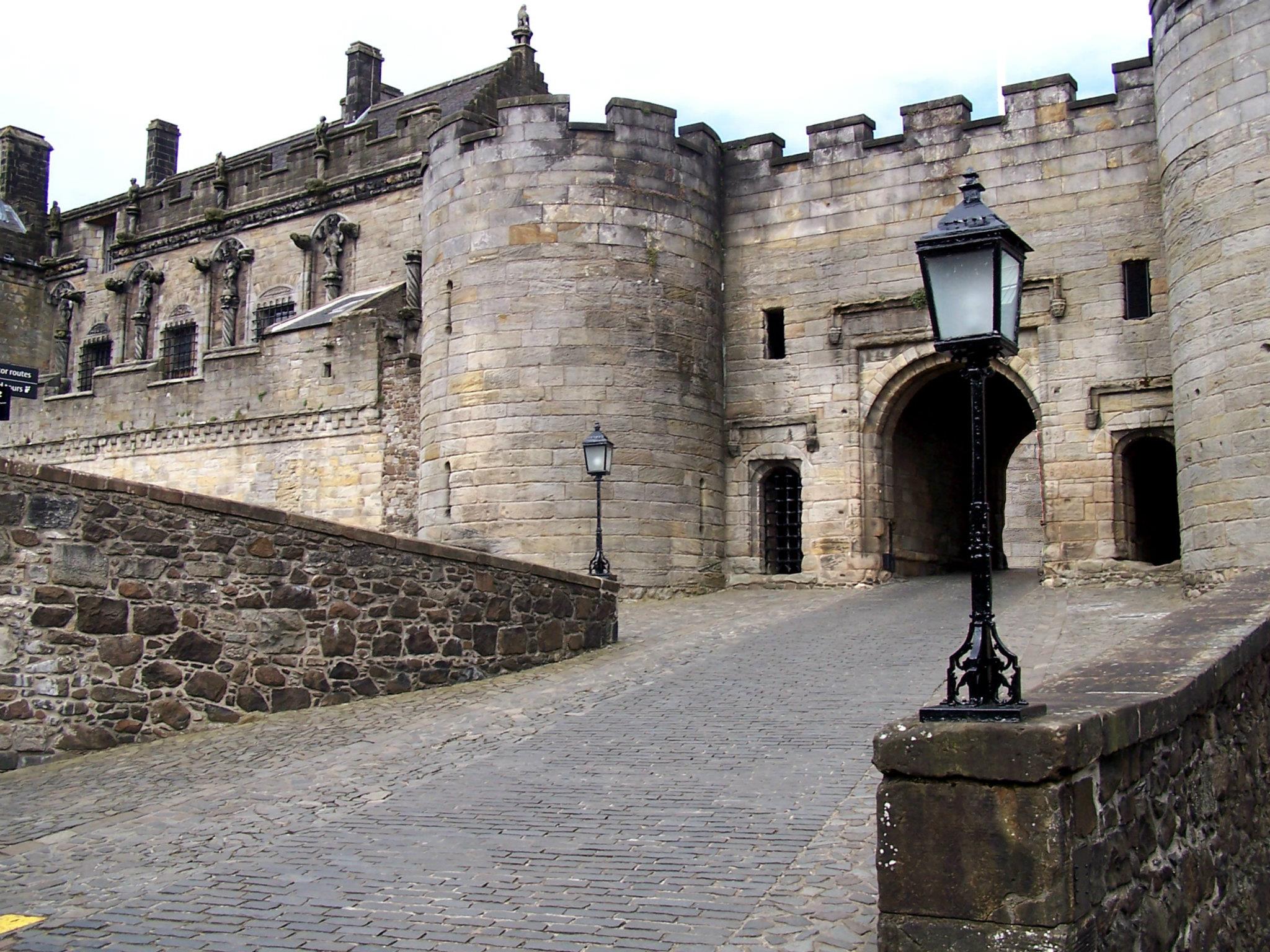
Stirling’s importance begins with the landscape. From its volcanic rock, the castle guarded a crucial crossing of the River Forth. First mentioned around 1110, it became a royal residence and a fiercely contested stronghold during the Wars of Independence. Stirling Bridge and Bannockburn were fought nearby; the castle belonged to the same struggle for control of the country.
The buildings around the Inner Close reveal successive royal ambitions. James IV added the King’s Old Building in 1496 and the Great Hall around 1503. James V’s palace followed around 1540, bringing an elaborate Renaissance court to the fortress. The Chapel Royal standing today was commissioned by James VI in 1594.
Mary, Queen of Scots was crowned here as an infant in 1543 and spent part of her childhood at Stirling. Her coronation belonged to an earlier chapel, rather than the building visitors enter today. Remembering that change helps make sense of a castle repeatedly rebuilt around its royal occupants.
02 / Reading the building
A court brought back into view
Stand in the Great Hall and imagine the work behind a royal feast: food arriving from service rooms, music above, and attention directed towards the raised dais. Five fireplaces warmed this enormous gathering space. Its later conversion into barracks divided the interior; restoration between 1964 and 1999 recovered the hall’s medieval form from the surviving evidence.
The palace’s carved oak Stirling Heads bring another kind of company. Their faces belong to a sixteenth-century decorative scheme, but their survival owes much to people who cared about them later. In the nineteenth century, Jane Ferrier drew the scattered carvings and published them. Her illustrations helped preserve knowledge of heads subsequently lost. Among Stirling’s extraordinary faces, these are ones whose history can be followed.
03 / History and haunting tradition
The fire behind the Green Lady
A sleeping queen, a candle and burning bed curtains sit at the heart of Stirling’s best-known haunting. VisitScotland tells of a servant who saves Mary, Queen of Scots from the flames but loses her own life. Her presence in green is said to remain at the castle. Later appearances are often interpreted as warnings of danger, especially fire.
There is a contemporary documentary trail for the fire. Writing to William Cecil on 24 September 1561, the English diplomat Thomas Randolph relayed his servant’s news that Mary’s bed hangings had caught alight while she slept, almost suffocating her. Joseph Bain’s published calendar preserves the passage. Randolph also mentioned an old prophecy about a queen burning at Stirling, treating it sceptically. His report does not identify a rescuing girl or record her death.
The tradition has grown in different directions. Laurie Risk’s HES retelling makes the girl a watchful attendant whose drowsiness causes the very fire she fears. Whether rescuing the queen or falling victim to a dreadful prediction, she becomes the human centre of the story. Her identity and fate remain unestablished; the real fire gives the legend a historical setting without settling its supernatural meaning.
Sources for this section · 4
- VisitScotland — Ghost Trail, entry 9: The Green Lady of Stirling Castle (opens in a new tab)
- Joseph Bain, editor — Calendar of Scottish Papers, vol. I (1898), p. 555, no. 1023: Randolph to Cecil, 24 September 1561 (opens in a new tab)
- Laurie Risk, HES — Ghost Stories from Stirling Castle (20 October 2023) (opens in a new tab)
- Martin Coventry — The Castles of Scotland: Green Lady tradition (opens in a new tab)
04 / Stories beyond the walls
The Pink Lady’s unfinished search
The Pink Lady draws the story out towards the kirkyards and Ladies’ Rock. Scottish Paranormal’s earlier account describes a woman searching for a husband lost during Edward I’s siege in 1304. Other retellings identify her with Mary, Queen of Scots. These are competing interpretations of the figure, rather than a settled biography.
HES records a subtler version: a pink presence around the kirkyards, accompanied by a feeling of longing. That differs from seeing a clearly defined woman in a gown. Keeping those descriptions intact lets each account retain its character. The traditions share a theme of attachment to someone who has gone, but do not establish one woman’s identity.
05 / A familiar-looking stranger
The soldier mistaken for a guide
The Highlander’s unsettling quality is how ordinary he initially seems. In the familiar story, a man in Highland dress blends into the castle until someone approaches him and he disappears. Martin Coventry also records the claim that a kilted figure was photographed in 1935. The original photograph’s provenance and circumstances need establishing before it can carry the weight often placed on it.
Derek Green’s 2008 Ghost Club report relays a different encounter: a visitor said a Highland-dressed man helped her out of Elphinstone Tower after the lights went out. When she later tried to pass on her thanks, staff reportedly could not identify a colleague dressed that way. It is a second-hand account within the report, separate from what the investigators themselves experienced that night.
06 / Published experiences
A turning handle and a night of investigation
HES writer Laurie Risk recalls a door handle turning as she descended towards a room beneath the Prince’s Tower. On another occasion, she found fallen uniform rails and heard windows rattle. Risk remains sceptical about ghosts; her own account preserves both the incidents and her interpretation without identifying their cause.
The Ghost Club’s investigation on 2 March 2008 provides a dated record with named participants. Its published report includes quiet vigils alongside subjective impressions, changing electromagnetic readings and a camera switching off and on. One fireplace check produced disagreement between meters. Those details matter: the observations and their possible explanations need considering together.
Green’s article is an abridged report, with fuller records mentioned separately. It offers leads for research, rather than a demonstrated explanation for the castle’s reputation. The value of an investigation grows when the ordinary stretches of a night survive alongside its surprises.
07 / From the Scottish Paranormal archive
An exploration of Stirling’s stories
Haunted Scotland’s archive reaches back to a February 2013 Stirling Castle photography entry. Ryan O’Neill’s October 2024 article describes a visit to gather information and explore the castle’s atmosphere, introducing its three familiar ghost traditions. These publications connect this guide with our earlier work; the articles do not document a personal apparition or a controlled investigation. Spend time with the actual place, and let its history deepen the questions you bring.
08 / Plan a visit
Leave time for the climb and the courtyards
Stirling Castle is at Castle Wynd, FK8 1EJ, approximately half a mile uphill from the railway and bus stations. Book through Historic Environment Scotland and check current notices before setting out. At the review date, the castle car park was closed to vehicles except coaches and those requiring accessible parking; HES listed alternative parking in the city.
The approach and courtyards include slopes and cobbles. Ask entrance staff about the mobility vehicle to the Inner Close; availability depends on trained staff, and wheelchair or scooter dimensions need checking. The Great Hall and Chapel Royal have level entrances from the courtyard. Its detailed access information and visual guides will help you choose a route. Museum closing times can differ from the castle’s.
Give the royal rooms, military collections and open views their own time. If something unexpected catches your attention, record the location, time, nearby people and conditions while the memory is fresh. A clear description keeps the experience available for thoughtful discussion.
Sources for this section · 1
Prepared for Scottish Paranormal / Haunted Scotland.
Sources and visitor information reviewed 15 September 2026.