01 / The documented castle
From an island home to a Deeside tower
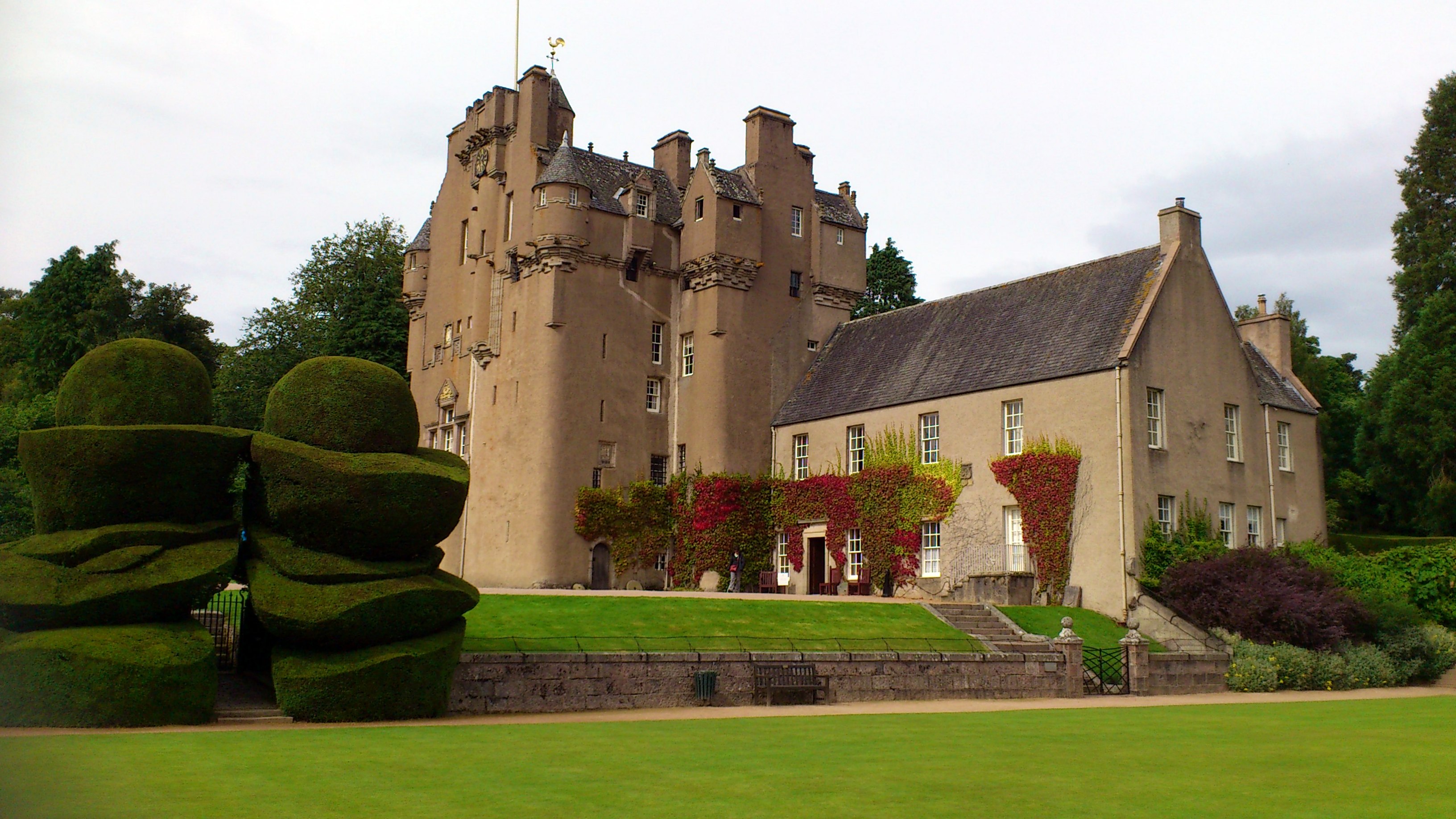
The Burnetts’ story here begins before the present castle. Robert the Bruce granted the family land in 1323; their earlier home stood on a crannog, an artificial island in the Loch of Leys. The move to Crathes brought them out of the water and into an increasingly elaborate residence overlooking the Dee valley.
The familiar construction dates are 1553–1596, but the building deserves more than a single start-and-finish line. National Trust for Scotland surveyor Annie Robertson points to evidence of successive stages: part of the tower may already have stood by 1553, with its lavish upper work developed later. The carved dates are clues to a changing home.
Church connections helped enlarge the family’s property. The 1901 family history identifies Janet Hamilton, wife of Alexander Burnett, as the daughter of Canon Robert Hamilton, and records land grants to the couple in 1543. Their names and family arms belong to the castle’s story of wealth, marriage and ambition.
02 / Reading the building
A household written overhead
Crathes rewards slow looking. Its painted ceilings include the Muses and celebrated figures from history and legend. Heraldry places the Burnetts among them. These rooms expressed the household’s learning, connections and aspirations; imagine the conversations carried on beneath that extraordinary decoration.
There are more practical reminders of castle life below: vaulted storage, a kitchen and an iron gate protecting the entrance. At the top, the long gallery made space for leisure within the narrow tower. The building could announce authority while accommodating the ordinary business of living.
Later generations added an eighteenth-century wing. The National Trust for Scotland took over the castle in 1951. A serious fire in 1966 damaged the later wing, which was rebuilt at a lower height. Crathes has survived through adaptation and care, as well as through the preservation of its remarkable older rooms.
03 / Family folklore
The phantom from the Loch of Leys
One haunting begins at the Burnetts’ island home. In Fenton Wyness’s tale, reproduced by the Burnett family, Bertha de Bernard falls in love with young Alexander. His mother, Lady Agnes, has a grander marriage in mind.
Alexander leaves on land business. Bertha sickens and dies. Returning to find her body, he reaches for a cup of wine; his mother snatches it away and throws it into the loch. In the story, that gesture reveals poisoning. When Bertha’s father later confronts Agnes, she cries out at something unseen and collapses dead.
The ending carries the tragedy across the landscape. Once a year, a woman’s phantom is said to travel from the old island site towards Crathes. Wyness preserves two identities: Bertha seeking the home associated with her lover, or Agnes condemned to wander. Neither should be quietly replaced with a single, certain answer.
This is a family legend recorded in a named retelling, rather than an established murder case. The changing identity of its phantom is part of the story’s fascination.
Sources for this section · 1
04 / The haunting tradition
A woman, a child and the hearth
Crathes’ best-known ghost belongs to a room inside the castle. The Green Lady is described as a young woman in green, holding an infant near the fireplace. In familiar retellings, she crosses the room and disappears into the hearth or adjoining wall. The image is memorable precisely because it feels domestic: someone who ought to have been safe at home.
The National Trust for Scotland repeats a story that a child’s bones were found beneath the hearth during nineteenth-century renovation. The Great Castles retelling describes a young woman and baby. Those versions differ in a crucial detail. A contemporary record identifying the discovery and its circumstances has not been established in the sources linked here; the reported find cannot yet settle the woman’s identity or establish a murder.
Queen Victoria also appears among the claimed witnesses in the Trust’s telling. That is a traceable part of the tradition, but the linked account supplies no dated journal entry or first-person royal testimony. The queen’s alleged encounter remains an attributed story.
05 / Published experiences
Footsteps before opening time
The published accounts extend beyond the famous apparition. In an NTS collection of staff experiences, visitor services manager Doug Kyle describes arriving one morning, switching off the alarm and hearing rapid footsteps ahead as he went upstairs.
He then found doors open throughout the building, including cleaning cupboards. Kyle explained that staff normally shut them at closing and that, as he understood the system, the alarm could not be set with them open. He treated the incident with humour, imagining a presence helping him prepare for visitors.
It is a specific experience told by a named member of staff. The published piece provides his recollection, without a dated incident record or independent check of the alarm and doors. It leaves a worthwhile account to consider and questions about what happened that remain open.
A separate NTS feature by travel writer Robin McKelvie, published in July 2018, describes a reported temperature fall in the Green Lady’s Room during a 2011 sighting, while neighbouring rooms remained steady. It supplies no readings, equipment details or original records. That makes it a lead for further investigation; the article alone cannot tell us what caused the change.
06 / An older landscape
Before the castle: watching the moon
The most ancient mystery at Crathes lies in its wider landscape. At Warren Field, archaeologists investigated a line of prehistoric pits. A research team led by Vincent Gaffney proposed in 2013 that the arrangement, dating to the eighth millennium BC, functioned as an early way of reckoning time.
Their interpretation links the pit group to the moon’s changing phases and a midwinter sunrise alignment that could help keep lunar months in step with the seasons. It is a remarkable proposal about the knowledge and intentions of hunter-gatherers, often shortened in headlines to the world’s oldest calendar.
The study concerns prehistoric timekeeping. Connecting the site to the castle’s hauntings, or suggesting an energy that sustains them, is a separate speculation for which that archaeological work provides no evidence. The possibility of people studying the sky here thousands of years before Crathes was built is compelling in its own right.
07 / Plan a visit
Make time for the whole place
Crathes Castle is a National Trust for Scotland visitor property near Banchory, reached by its signed drive from the A93. Use postcode AB31 5QJ and follow the official approach: the Trust warns that some navigation systems suggest private roads.
Allow time for the walled garden and estate as well as the castle. On 15 September 2026, the Trust listed castle entry as first-come, first-served, with tickets bought in the shop. Check its current opening times, admission prices and notices before travelling; some estate trails were closed because of storm damage at the time of review.
The castle’s ground floor is wheelchair accessible; upper rooms require stairs, mostly narrow spirals. Most of the walled garden and the courtyard café are accessible. Read the Trust’s detailed access guide when planning your route.
If you notice something unusual, write down what happened, where you were and the conditions before comparing interpretations. A careful account can preserve a fleeting experience far better than a story reconstructed afterwards.
Sources for this section · 1
Prepared for Scottish Paranormal / Haunted Scotland.
Sources and visitor information reviewed 15 September 2026.