01 / Documented history
The St Clairs above the river
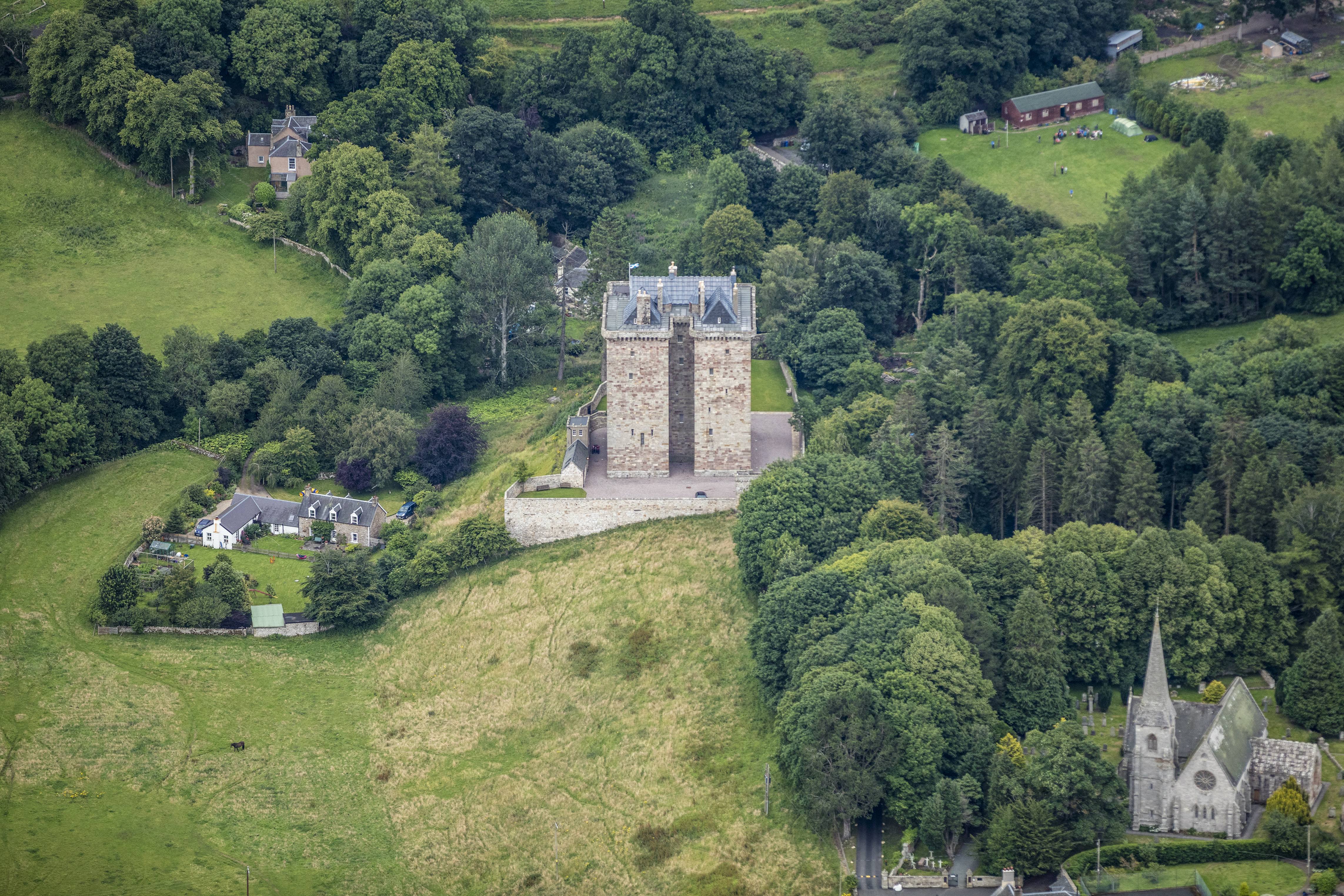
Rosslyn’s position explains much of its character. The North Esk curves around a steep promontory on three sides. Across the narrow connection to the surrounding ground, a deep cutting creates a further barrier, crossed by the stone bridge. The approach makes the relationship between the castle and its landscape unusually easy to read: water, height and a controlled entrance work together.
Historic Environment Scotland allows for a fortification here in the fourteenth century, but dates no surviving standing structure earlier than the fifteenth. That distinction matters when tracing the St Clair family’s long association with the site. An early castle and the masonry visible today need not be the same building.
William St Clair, Earl of Orkney and later Caithness, was a major fifteenth-century patron here and founded nearby Rosslyn Chapel in 1446. The two places share a family history, while offering different encounters with it. At the castle, the ravine and surviving fragments speak first of a defended household.
Sources for this section · 1
02 / Inside the architecture
A house with hidden depth
The east range can appear surprisingly modest from the courtyard. Seen from the glen, its depth becomes clear: the building rises through four or five storeys against the slope. Much of its working accommodation sits below the level from which the upper house is approached. Three lower floors are vaulted, giving the castle a substantial interior beneath that comparatively domestic skyline.
The listed-building record dates this range to 1597, with further work in 1622. A carved panel over the entrance bears the initials SWS and the latter date; a decorated plaster ceiling is dated 1623. These details belong to a household investing in comfort and display as well as substantial walls.
A scale-and-platt stair links the levels: straight flights separated by landings, rather than a continuous spiral. It gives a useful physical setting for the encounter told below. The architecture is documented; identifying a person allegedly seen on those stairs is a different question.
Sources for this section · 1
03 / War and survival
When the guns reached Rosslyn
The castle suffered during the Rough Wooing in 1544, when English military campaigns sought to force a marriage between the young Mary, Queen of Scots, and the future Edward VI. A century later, another English army brought a new assault. In November 1650, Colonel George Monck’s forces attacked Rosslyn during Cromwell’s campaign in Scotland.
The Landmark Trust’s history album reproduces reports from the Parliamentarian newsbook Mercurius Politicus. They describe Monck advancing against the castle, using guns and grenades, and securing its surrender. One report puts the defenders at twenty-five or twenty-six. These are accounts from the attacking side, and their perspective belongs alongside the detail they preserve.
The Great Hall remained without a permanent roof after the 1650 attack until the recent conservation project. Yet the castle’s story continued through its surviving house. Ruin and occupation developed beside one another, leaving a place whose appearance cannot be explained by a single moment of destruction.
04 / A named witness
The man on the stairs
In August 2014, Australian author Jeanette Harvey published an account on her Sisters of The Bruce website of something she remembered seeing at Rosslyn roughly a decade earlier. It was dusk. A man appeared a few steps below her, with dark, shoulder-length hair and rough brown clothing. She described him as solid-looking, rather than transparent, and did not think he acknowledged her.
The figure continued down and around the corner of the staircase. In a comment beneath her article, Harvey added that she had been staying with relatives and followed him, but found nobody when she looked around the corner. The relatives’ presence establishes the circumstances of her stay; she did not identify them as additional witnesses to the figure.
Harvey understood the encounter as ghostly and wondered whether a scene from the past could somehow be replayed. That is her interpretation of a remembered experience. Her account gives us a witness, a setting and an approximate period, while leaving the figure’s identity and disappearance unresolved.
Sources for this section · 1
05 / Castle folklore
The hound that would not leave
A different kind of story attaches Rosslyn to the Battle of Roslin in 1303. In the version preserved in our earlier castle guide, an English knight is killed and his faithful hound attacks the Scottish soldier responsible. The soldier kills the animal too. The story then follows him back to the castle, where the hound begins appearing in the guardroom.
Its nightly return terrifies the garrison. Eventually the soldier confronts it, a terrible cry is heard, and he dies within three days. With that death, the appearances end. Loyalty, violence and a debt finally settled give the legend its shape; the animal remains devoted to its master beyond the battlefield.
The account supplies no named witness or contemporary record for the apparition. Its connection with 1303 is part of the tradition, not a date established for a haunting in the surviving castle. It belongs alongside Harvey’s account as folklore with a different history of transmission, rather than another report from the same evidence.
Sources for this section · 1
06 / A continuing home
A roof returns to the Great Hall
In July 2024, Rosslyn Chapel Trust announced the completion of a two-year conservation project at the castle. A permanent roof returned over the Great Hall and Tower, protecting carved masonry and the vaulted chambers below. New living space also helped bring these long-exposed parts of the building back into use.
Traditional materials and specialist craft skills were central to the work. Alongside them came modern services: six air-source heat pumps were installed in the sixteenth-century vaults to provide heating and hot water. The combination is revealing. Caring for Rosslyn involves maintaining a place people can occupy as well as protecting the fabric that makes it historically important.
Our six-minute Haunted Scotland film, published in February 2018 and narrated by Ryan O’Neill, offers an earlier view of the setting and its stories. Watch it with the later work in mind: it predates the new roof. The film is an introduction to the location and its haunting traditions, rather than a current guide to the building’s condition or access.
07 / Plan a visit
Give the castle and the glen their own time
Rosslyn Castle’s accommodation is offered through the Landmark Trust for stays of up to eight people. It should be approached as a booked holiday property. An outdoor walk does not include permission to enter the house or explore the internal staircase, and the accommodation’s parking arrangements are for its guests.
For the surrounding landscape, Midlothian Council’s Roslin Glen Country Park information is the useful starting point. It identifies free park parking and woodland and riverside paths, with connections to the castle, chapel and village. Use the current route information, allow for the weather and follow any signs or temporary restrictions on the ground.
Rosslyn Chapel has its own visitor arrangements and booking system. Treat it as a separate stop, with enough time to enjoy the glen rather than rushing between buildings. If you are considering a castle stay, discuss stairs and any specific access needs with the Landmark Trust before booking. Visitor information checked on 16 September 2026; follow the linked operators for current arrangements.
WATCH / HAUNTED SCOTLAND
Watch the Rosslyn film
Explore the castle through the existing Haunted Scotland location film, then return to the history and attributed accounts above.
Prepared for Scottish Paranormal / Haunted Scotland.
Sources and visitor information reviewed 16 September 2026.