01 / The documented castle
A tower at the heart of a changing household
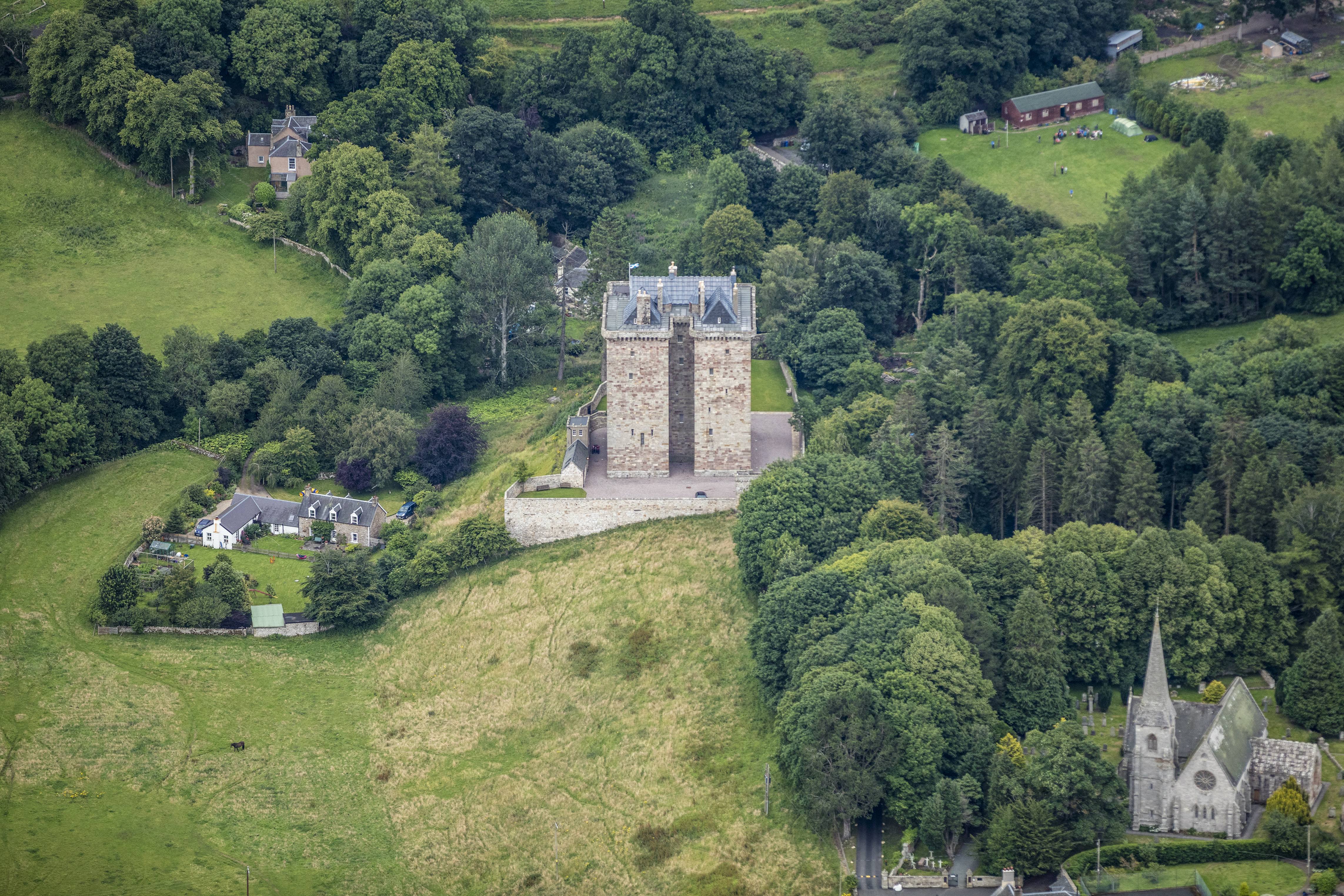
Historic Environment Scotland dates the beginning of the surviving castle to around 1400. The earliest tower stands in the eastern range; later buildings gathered around it through the fifteenth and sixteenth centuries. This is a place to read in layers, with an older residence still visible inside a much larger architectural ambition.
John de Crichton is associated with the tower’s construction. HES’s detailed assessment cautions that no precise building date is established, although a late fourteenth-century origin is probable. Its vaulted lower spaces and hall above expressed the needs of a household whose lord had both possessions to protect and guests to impress.
The monument includes more than the standing walls. Its surrounding ground contains evidence of ancillary buildings, earthworks and the quarries that supplied its stone. The apparently empty slopes remain part of the castle’s history.
02 / Power and historical tradition
William Crichton and the shadow of the Black Dinner
John’s son William became Chancellor of Scotland in 1439. His enlargement gave the castle a formal courtyard, an imposing hall and the service rooms that supported grand hospitality. The nearby collegiate church, founded in 1449, also expressed his family’s position: priests were paid to pray for their salvation.
William’s name is bound to the Black Dinner of 1440, when the young Earl of Douglas and his brother were executed following a banquet at Edinburgh Castle. Later stories place two days of preliminary hospitality here at Crichton, with their host concealing what awaited them in Edinburgh.
HES treats that local episode as a story recorded in later accounts. Its assessment stresses how little contemporary evidence survives and questions the familiar claim that Crichton was besieged in 1444. The political connection matters; the banquet that ended in death took place at Edinburgh Castle, while the supposed feasting here requires that qualification.
03 / A royal connection
Mary’s visit, and two very different Bothwells
The castle passed to Patrick Hepburn in 1488, as he rose to become Earl of Bothwell. The fourth earl, James Hepburn, later married Mary, Queen of Scots. That 1567 marriage makes his name familiar, but it should not draw every event in their troubled relationship back to this castle.
Mary did visit Crichton in 1562 for the wedding celebrations of Bothwell’s sister Janet Hepburn and the queen’s half-brother John Stewart. The occasion offers a specific reason to picture a royal party arriving here. HES records no new building work at Crichton by James Hepburn.
The striking transformation belonged to Francis Stewart, the fifth earl, who returned from travels in France and Italy and made Crichton one of his favoured residences. His ambitions survive most clearly in the north lodging, where the architecture takes an altogether different direction.
04 / Renaissance architecture
A wall that catches the light differently
The courtyard face of the north lodging is Crichton’s great surprise. Above its open arcade, carved stone blocks project in a repeated diamond pattern. This treatment, known as diamond rustication, turns a flat wall into a surface of changing light and shade. The work belongs to Francis Stewart’s rebuilding in the later sixteenth century.
Comparable decoration appeared on prestigious buildings in Italy, Spain and Portugal. HES discusses examples such as the Palazzo dei Diamanti in Ferrara, but says the precise source of Crichton’s design remains unidentified. Francis’s Italian itinerary is too uncertain to prove that he personally saw any particular model.
At Crichton the blocks align vertically and have flattened tips, giving the façade its own character. The lodging also contains a staircase arranged in straight flights with landings, a significant departure from the familiar castle spiral. These are features of the historic interior; the present closure means a grounds visit cannot promise access to them.
05 / Beyond the grand rooms
The surviving stable and the ground beneath
A separate roofless building stands to the south. It is interpreted as a stable with accommodation above, although its unusual appearance has encouraged visitors to mistake it for a chapel. HES attributes it to Francis Stewart’s patronage. Other low remains nearby suggest a busier settlement around the noble residence.
Excavation in 1985 examined the tower basement and the northern courtyard. John Lewis’s published report records limited results in the basement, where modern drainage had disturbed the floor, but earlier wall foundations beneath the later arcade. Their interpretation helps explain how successive builders reused and changed the same ground.
After Francis fled Scotland in 1595, ownership remained contested; HES finds the castle evidently ruined and abandoned by 1659. Its later life included literary fame through Walter Scott’s Marmion, published in 1808, and entry into state care in 1926. Its survival brings several centuries into one view.
06 / The reported horseman
A rider at an entrance that has gone
Scottish Paranormal’s original Crichton entry preserves a short tradition: a man on horseback enters the castle through its original, no longer surviving gate. The same passage appears twice in that source. It gives no witness name, sighting date or identity for the rider.
The longer Scottish Paranormal article published in January 2025 develops the account. Its horseman crosses the moors and vanishes through a wall said to contain a blocked entrance; it also describes a figure leaving the stable block. That retelling suggests William Crichton, then Francis Stewart because the stables belong to a later building phase.
These names remain proposed identities within the story. Neither article supplies a dated witness statement or enough detail to map the reported route confidently onto the surviving fabric. The image of a rider following a lost approach is memorable on its own. The architecture provides context, but cannot establish who was seen or what caused an experience.
07 / Planning a visit
Plan for the grounds and exterior
Checked on 15 September 2026, HES states that the castle is closed for conservation and can be viewed through protective fencing. The surrounding grounds remain open. Its current page supplies no castle opening timetable or reopening date, so check the official information again before travelling, especially if seeing the courtyard is central to your plans.
The official address is Pathhead, southeast of Edinburgh, EH37 5XA. HES lists car parking and welcomes dogs in outdoor areas. Undiscovered Scotland describes the approach from a car park beyond the collegiate church, with the castle reached along a track of roughly 500 metres. Treat that older route description as orientation and follow current signs and barriers.
Allow time for the approach and a slow look at the castle against the valley. For specific mobility needs, contact the property before setting out. Keep the visit outside the conservation enclosure; older photographs of the courtyard show features that may currently be beyond reach.
Prepared for Scottish Paranormal / Haunted Scotland.
Sources and visitor information reviewed 15 September 2026.