01 / The documented castle
A household built to endure
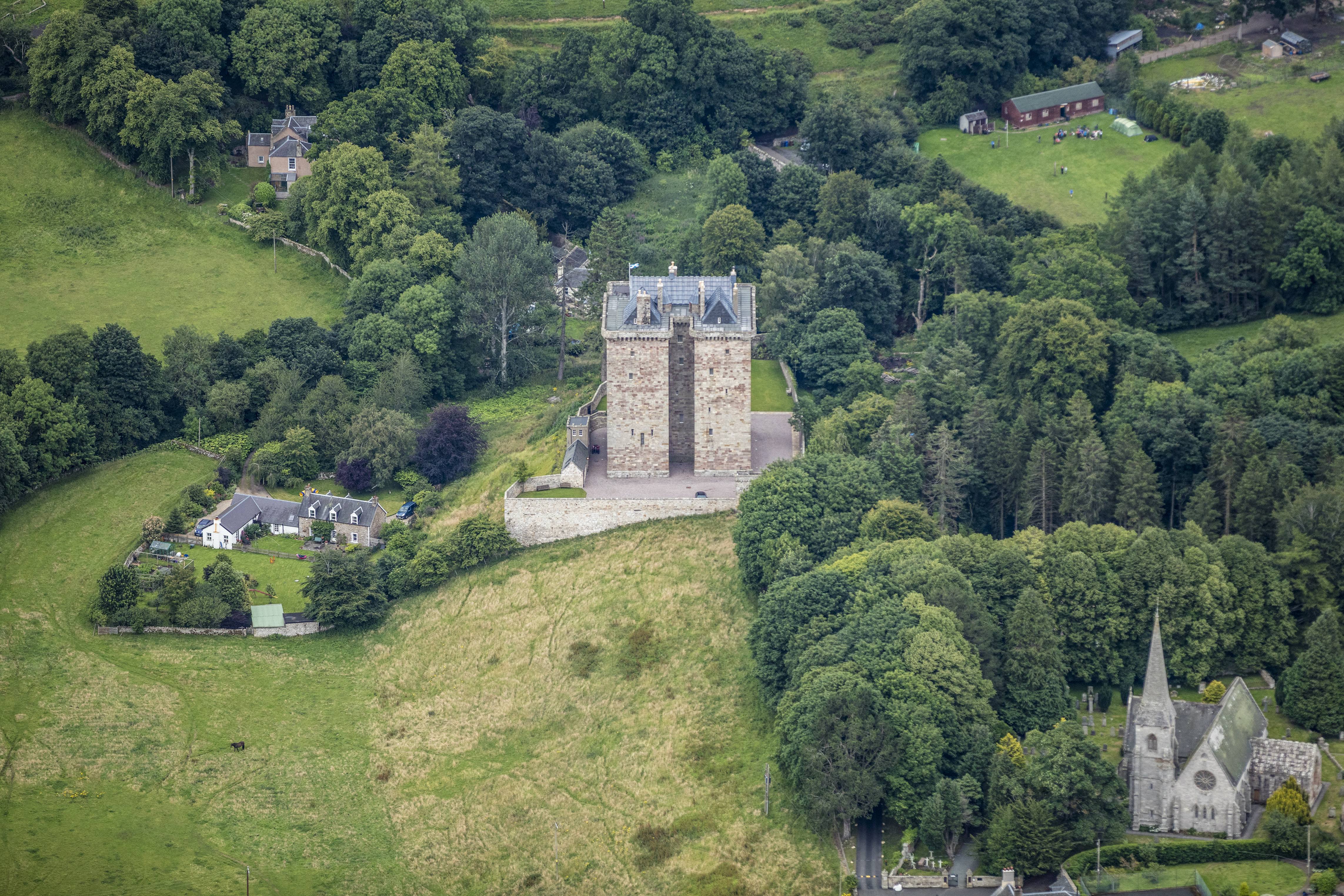
Sir William Borthwick received a royal charter to build here on 2 June 1430. He had acquired the estate from the Hays, and the new castle became his family’s seat. Historic Environment Scotland identifies it as an unusually complete fifteenth-century keep, protected today as a Category A listed building.
The U-shaped plan placed tall wings around a central range. Vaulted storage lay below the Great Hall, with chambers and service stairs arranged through the building. Its medieval interiors would once have included plaster and colourful painted decoration. The bare-stone image of castle life tells only part of the story.
The present venue still uses the vaulted Great Hall for dining and celebrations, with a State Room above and the Garrison at the top. These names give a useful route through the house: spaces for gathering, retiring and looking out over the countryside, stacked within an imposing shell.
02 / Royal history and haunting tradition
The queen and the page-boy figure
In June 1567, Mary, Queen of Scots and her husband, James Hepburn, Earl of Bothwell, took refuge at Borthwick. Opposition to Bothwell brought armed nobles to the castle. He escaped, and Mary followed. The castle’s published history recounts her departure dressed as a page, a disguise that has become central to Borthwick’s identity.
The haunting follows that remembered escape. In his 2009 Ghost Club article, Derek Green describes reports of a page-boy apparition in the castle, identified by some as Mary. Martin Coventry’s castle guide places the reported figure between the castle and nearby churchyard. Those are distinct settings in the published versions.
Neither account supplies a named witness and date for that sighting. The historical association explains why Mary’s name comes readily to mind; identifying an unfamiliar figure is a further step. The ghost story remains an intriguing echo of the queen’s most precarious days.
03 / A letter and a disputed scar
What the east wall can tell us
A summons dated 18 November 1650 gives Cromwell’s confrontation with Borthwick a documentary voice. Reproduced in The Scots Peerage, it offers the governor departure with his company, weapons and goods if he surrenders the house. Refusal brings the threat of cannon. Even in paraphrase, the terms leave little doubt about the pressure on those inside.
The conspicuous gash in the east wall is commonly attributed to that episode. Historic Environment Scotland records several possible explanations, including bombardment and decay. Its description does not settle the cause. The letter establishes a threat; it cannot, by itself, identify every missing stone. Look at the damage with both the confrontation and that uncertainty in mind.
04 / The haunting tradition
Ann Grant and the Red Room
The Red Room carries Borthwick’s most troubling legend. In the version recorded by Martin Coventry and preserved in our earlier article, a young woman named Ann Grant becomes pregnant by a Borthwick lord. She is killed in the room before her child is born. The 2012 archive says a visitor and a former owner reported seeing the death replayed, while staff at the time had not witnessed it.
Other tellings change an important detail. Betsa Marsh’s 1997 British Heritage feature describes a servant and her already-born son being killed. The castle’s current Red Rose bedchamber description also recalls a chambermaid murdered with her son, and says a red rose is kept in her memory. The tradition has continued into the building’s modern life.
Those versions should remain visible. A name, a pregnancy and a murdered child give the story emotional force, but the sources linked here do not establish a dated murder record or identify the responsible lord. We can preserve the story without deciding that every detail belongs to one documented event.
Marsh also reports that an Edinburgh priest was called to perform an exorcism. Her article gives no service record or clear outcome; it records another chapter in the room’s reputation.
Sources for this section · 4
- Martin Coventry — Borthwick’s Ann Grant tradition (opens in a new tab)
- Scottish Paranormal archive — Borthwick Castle (22 March 2012) (opens in a new tab)
- Betsa Marsh — The Ins and Outs of Borthwick Castle, British Heritage (23 September 1997) (opens in a new tab)
- Borthwick Castle — Red Rose bedchamber (opens in a new tab)
05 / From the published archive
A woman in a chair, and someone behind you
Our article published on 22 March 2012 preserves an account attributed to Wilma Martin, identified there as the hotel’s manager. She describes guests mentioning doors moving and lights switching, and recalls one guest who reported a woman sitting in her room. According to Martin, that guest had not known Ann’s story beforehand.
Martin also describes sometimes sensing someone behind her, then turning to find nobody there. She relays staff accounts of hearing children when no children were present. Her own sensation, a guest’s sighting and colleagues’ reported sounds are different kinds of testimony; keeping them distinct preserves what she actually said.
The earlier article also lists temperature changes, scratching, footsteps and sobbing, but gives no readings or dated incident logs. Its account of the manager is valuable as a named historical source, while the original interview and individual witnesses remain untraced. These are published recollections from the castle’s hotel years, with causes still open to investigation.
06 / Further stories
Gold, punishment and the gap between the towers
Marsh records another alleged presence: a family chancellor said to have stolen money and been burned to death. Her retelling treats the accusation as gossip. It supplies no named official or dated prosecution with which to test the story.
Our earlier archive also repeats a grim challenge: prisoners supposedly offered freedom if they could leap between the towers with their hands bound. That is a castle legend, with no identified prisoner’s account in the linked material. The narrow divide is real; the punishment story needs its own evidence.
07 / Plan a visit
Arrange your castle time in advance
Borthwick now operates as an exclusive-use venue for weddings and private stays. Its current website does not advertise ordinary walk-in castle admission. Contact the venue before planning access to the building or grounds, and respect the privacy of the people staying there.
The address is North Middleton, Midlothian, EH23 4QY. The castle recommends the approach through North Middleton from the A7. Its contact page also points rail travellers towards Gorebridge; arrange the onward journey as part of your visit.
Many bedrooms are reached by spiral stairs. Discuss the specific rooms and routes you need with the venue before booking, particularly if stairs present a difficulty. Present-day arrangements were checked on 15 September 2026; older hotel reviews describe an earlier operation. Come for the architecture and history, with the haunting accounts adding another perspective on a remarkable home.
Prepared for Scottish Paranormal / Haunted Scotland.
Sources and visitor information reviewed 15 September 2026.