
01 / Which Alexander Lindsay?
The earl behind the stones
Lordscairnie is often called Earl Beardie’s Castle, linking it to Alexander Lindsay, fourth Earl of Crawford, who died in 1453. The University of Glasgow’s Fife place-name research makes the history more interesting: it favours his younger son, another Alexander Lindsay, as the likely builder of the surviving castle. A famous name has overshadowed a more plausible building campaign.
The younger Alexander held the lands by 1480 and became seventh Earl of Crawford in 1513. He died in 1517. This chronology fits a tower dated around the turn of the sixteenth century, rather than requiring the surviving structure to belong to his father’s lifetime. The attribution remains a scholarly conclusion, not a signed foundation stone.
The same research identifies a grant of 18 December 1525 as the first explicit documentary reference to the castle and mansion of Cairnie. That date records a building already in existence. It gives us a firmer foothold than a repeated claim that one particular year marks the laying of its foundations.
Sources for this section · 1
02 / A house built to command attention
Reading the broken tower
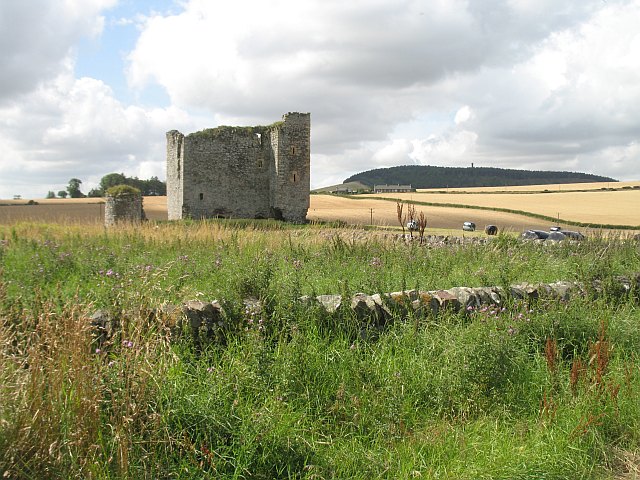
The surviving shell belongs to an L-plan tower house: a tall rectangular main block with a projecting stair wing. Martin Coventry’s architectural account describes four storeys with an attic above, a vaulted basement and a first-floor hall. Private rooms occupied the upper levels. Lordscairnie was a substantial household, with daily life arranged vertically behind formidable walls.
Its defensive details deserve a closer look through binoculars or a camera from an appropriate viewpoint. A projecting feature above the entrance allowed defenders to protect the doorway from overhead. Small corner turrets once helped watchers look along the walls. These details gave a residence the appearance and practical advantages of a stronghold.
The separate round tower belonged to the enclosing courtyard wall, or barmkin, rather than another freestanding castle. Much of that enclosure has disappeared. The basement vault has also collapsed, leaving a ruin whose impressive height should never be mistaken for a safe interior. Imagine the missing floors and enclosure from outside; entering adds little to understanding the plan.
Sources for this section · 1
03 / Before the standing walls
The settlement beneath the castle
Archaeological work in 2000 investigated the ground around Lordscairnie ahead of a proposed restoration. A. Dunn’s report, preserved in Historic Environment Scotland’s record, describes trial trenches and geophysical survey. Together they revealed a more complicated past than the visible stone tower alone suggests. The building occupies a place where people had already left earlier traces.
Medieval features included phases of a dry ditch, timber buildings and a possible palisade. Pottery helped distinguish this earlier occupation from the later Lindsay castle. There were also indications of possible prehistoric activity on the ridges, but its character and date remained uncertain. That evidence does not justify presenting a fully identified prehistoric fortress as an established fact.
Later use altered the site again. Stone was taken for other buildings and walls, while cultivation damaged earlier surfaces and courtyard remains. Excavation therefore had to work with a disturbed sequence. Even where a ditch can be recognised, its presence does not establish that water once filled it: the excavated early medieval ditch was interpreted as dry.
Sources for this section · 1
04 / The water that disappeared
An island remembered in farmland
Older descriptions place the castle on a slight rise within a watery landscape. The nineteenth-century Ordnance Gazetteer calls it a former islet in Lordscairnie’s lake and records drainage of the eastern portion around 1803. That account helps explain why a tower now surrounded by fields could once have occupied a more isolated position.
The gazetteer also describes the building being used as a source of stone. Its survival is therefore a history of removal as well as construction. When you look at the broken edges, consider the generations for whom the abandoned residence became useful building material. The neighbouring agricultural landscape is part of the castle’s later story.
Historic Environment Scotland now protects Lordscairnie as a scheduled monument. The designation recognises the historic site; it does not turn it into a staffed attraction. The most rewarding view may be the wider one, holding tower, low ground and fields together. It invites you to picture a changed setting without assuming that every old description supplies an exact medieval shoreline.
05 / The tale preserved in our archive
A stranger at the card table
Greg Stewart’s Scottish Paranormal feature, published on 31 December 2024, retells Lordscairnie’s Hogmanay tradition. Earl Beardie wants a game of cards on a Sunday, but his companions refuse to break the Sabbath. He declares that he would play the Devil himself. In the story, a stranger obligingly arrives, and the game continues towards midnight.
The stranger wins, reveals his identity and claims the earl’s soul. Lordscairnie’s particular sequel brings the scene back at Hogmanay: two figures are said to appear at a card table within the ruin. Anyone who stays watching until midnight supposedly risks losing their own soul. The warning turns a spectator into the next possible player.
Stewart presents an inherited haunting story, without a named eyewitness, dated encounter or investigation record. Its power lies in the bargain and the approaching hour. We preserve that tradition as folklore, while keeping the source of the telling visible. It supplies no reason to expect an apparition on a particular night, and no invitation to enter the ruin after dark.
06 / One story, more than one castle
Following the gambler beyond Fife
The card game also belongs to Glamis Castle’s traditions. Coventry records Earl Beardie condemned to play in a sealed room until the end of time, alongside an alternative identification of the gambler as Patrick Lyon, first Lord Glamis. Names, rooms and punishments shift between tellings. Lordscairnie is one setting within a wider tradition.
The Glamis page also reproduces an older account credited to Lady Glamis, published in a 1911 collection edited by Esther Singleton. There, two noblemen continue gambling as Saturday becomes Sunday; a stranger answers their defiance. The story describes an annual return, but places it in autumn rather than identifying Lordscairnie’s Hogmanay scene.
These differences are worth keeping. They show how a memorable warning could acquire a local setting and familiar historical figures. They do not establish where an original encounter happened, or even that there was one. For a reader drawn to Scottish hauntings, comparing the versions adds another layer: the castle preserves stone, while storytelling preserves a different kind of inheritance.
07 / Planning a considerate visit
Let the landscape frame the castle
Lordscairnie stands near Moonzie, northwest of Cupar. Current close-access arrangements could not be confirmed from an owner or operator when checked on 16 September 2026. Plan around a distant exterior view from a safe, appropriate position; seek local guidance before approaching across farmland. This guide cannot promise an open gate, a visitor path or access inside.
The Scottish Outdoor Access Code asks visitors to respect land management, crops, livestock and other people’s privacy. Use suitable paths and field margins where appropriate, keep away from farm operations and leave gates as you find them. If livestock make a route unsuitable, choose another approach or turn back. Park without obstructing entrances, passing places or agricultural traffic.
Daylight gives the best opportunity to understand the surviving masonry and surrounding ground. Keep clear of unstable walls, follow notices and barriers, and enjoy the outline from beyond the ruin. Binoculars can bring its defensive details closer. Give the tower and its changed landscape time to come into focus: a quiet exterior view can hold the whole story together.
READ / SCOTTISH PARANORMAL
Explore the archive
- PUBLIC ARTICLE · The Hogmanay Haunting of Lordscairnie (opens in a new tab)
Read Greg Stewart’s existing Scottish Paranormal folklore feature, published on 31 December 2024.
Prepared for Scottish Paranormal / Haunted Scotland.
Sources and visitor information reviewed 16 September 2026.

