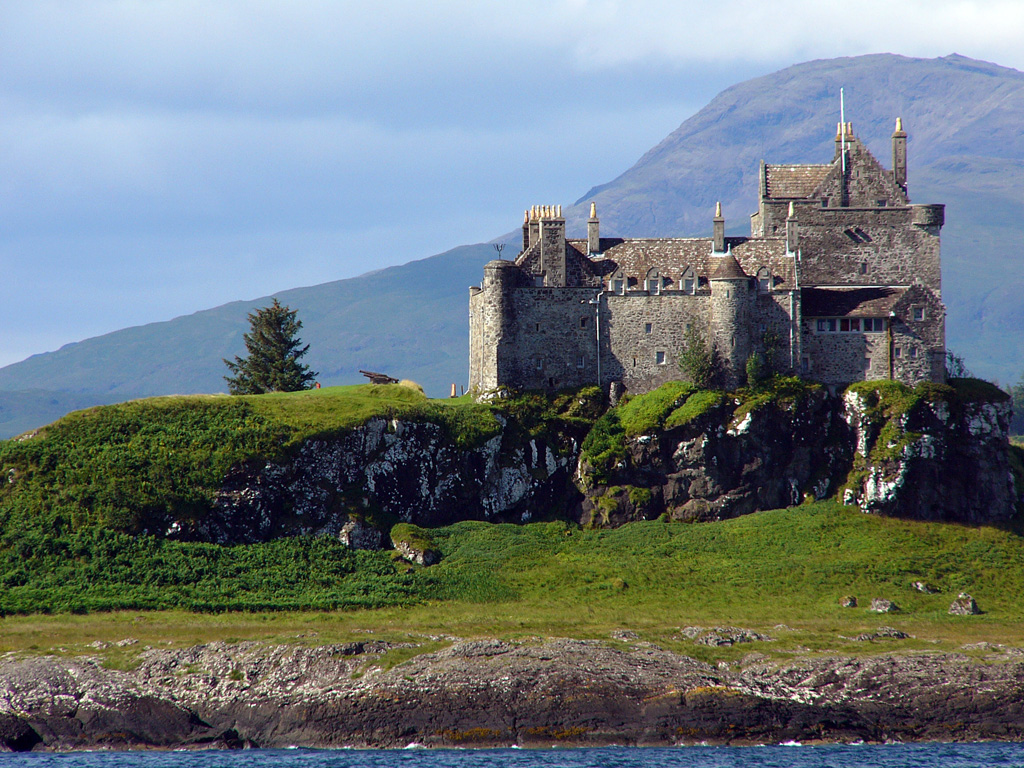
01 / The Campbells of Glenorchy
A stronghold at the head of Loch Awe
Sir Colin Campbell established Kilchurn in the middle of the fifteenth century. A charter issued at the castle in March 1449 places the building securely in the written record. Colin’s father had granted him Glenorchy lands, and the new residence helped establish a powerful branch of the Campbell family at the head of the loch.
The early castle combined a tower house with a defended courtyard. Within the tower were the practical and private spaces of lordship: storage, a hall, chambers and a prison. Colin’s son Duncan added a lower hall in the courtyard before his death at Flodden in 1513.
The Campbells of Glenorchy remained based here for roughly a century and a half. Later generations enlarged the castle, but their ambitions also drew them east to Balloch, now Taymouth, in Perthshire. Kilchurn’s changing role is part of that wider family story: an ancestral seat could retain importance even after its owners preferred another home.
Sources for this section · 1
02 / Traces of the people who made it
Masons, slaters and the problem of water
The archive notes gathered in HES’s Trove record bring individual workers into view. Agreements and accounts from the rebuilding of the 1690s name master mason Andrew Christy, slater Thomas Williamson and plasterer John Kelly. A later letter asks how much glazing was needed. The castle took shape through contracts, materials and skilled labour as well as a laird’s intentions.
Earlier repairs had already renewed the great tower and corner turrets. Records for 1643 describe a Perth wright, Andrew Scott, reroofing them and working on the lower hall. The ruin seen today is therefore the outcome of repeated repair, adaptation and eventual loss.
Water created another practical challenge. Excavation in 1993 examined drainage beneath the later barracks, which extended beyond the original rocky platform. Archaeologists found evidence of arrangements intended to collect and carry storm water away. Such details add texture to the distant silhouette: keeping Kilchurn habitable required constant attention to roofs, walls and the wet ground beneath them.
03 / An ancestral home adapted for soldiers
The barracks and the castle’s decline
John Campbell, first Earl of Breadalbane, undertook major rebuilding during the 1690s. The new barracks occupied the northern side of the courtyard, changing the balance of the whole complex. Rooms opened from corridors; each had a door, a window and a fireplace. Basement kitchens and latrines supported the accommodation above.
HES’s assessment places these buildings among the earliest purpose-built barracks in Scotland. They were used by government forces during the Jacobite rising of 1715, and again in 1745. The latter garrison included officers and militia tasked with controlling movement through the area. A castle originally expressing family authority had become a place within a wider military network.
Its useful life gradually ebbed away. By around 1770 the castle was unroofed, following lightning damage, and its exposed fabric deteriorated. HES also records a later use by fishermen preserving their catch. These changes give the empty ranges more than one past: family residence, soldiers’ quarters and working shelter before the familiar ruin emerged.
04 / The story of Black Colin
A broken ring and a return before the wedding
Maud Isabel Ebbutt’s collection, first published in 1910, retells Kilchurn’s homecoming legend as the story of Black Colin of Loch Awe. Before travelling abroad, Colin divides a gold ring with his wife. His half is to be returned if he dies. Years pass, and a rival suitor arranges false news of his death.
The lady delays another marriage by insisting that a new castle must first be completed. Secretly, she prolongs the building work. Colin eventually returns in a beggar’s disguise and asks to receive wine from the bride herself. He places his half of the ring in the bowl; recognition follows, and preparations for a wedding become a celebration of reunion.
Ebbutt places her hero in an earlier period than the documented fifteenth-century castle. Her version belongs to romantic storytelling, not a reliable family chronology. Its lasting appeal lies in the lady’s resourcefulness and the small object that overcomes years of separation: a private token carrying more weight than convincing rumours.
05 / The reported haunting
A voice asking for help
A different tradition appears in Richard Jones’s Haunted Britain, in an excerpt reproduced with his permission by Great Castles. Jones describes visitors hearing a distressed voice calling for help. The explanation attached to it concerns a child said to have been confined in an upper room at some unspecified point in the castle’s history.
The account gives neither the child’s identity nor a reason for the confinement. It also leaves the child’s fate unrecorded. No named witness, encounter date or detailed description of conditions accompanies the reported cries in the excerpt. Those limits matter: the story can be traced to a named author, but the underlying experiences cannot be reconstructed from this short telling.
The tradition deserves that careful distinction. It records a claim about something heard and a separate explanation offered for the sound. The explanation remains unverified. There is no basis here for adding a tragic biography, identifying a particular surviving window or presenting the castle as a place where visitors should expect to hear it themselves.
06 / Kilchurn through a traveller’s eyes
The Wordsworths and the changing water
Dorothy Wordsworth saw Kilchurn on 31 August 1803, after flooding had surrounded it with water. In the journal passage reproduced with her brother’s poetry, she describes mist, scattered sunshine and the castle appearing to rise from the loch. Their local guide explained that dry weather could make the site reachable on foot. The apparently permanent island was a changing scene.
William began his Address to Kilchurn Castle during that encounter, though the poem was developed later and published in 1827. It imagines the ruin’s relationship with water, wind and mountains, and reflects on power surviving in altered form after its practical purpose has passed.
These are literary responses to a real place, rather than records of a ghost encounter. They offer another way to spend time with Kilchurn: notice the light, the shoreline and the scale of the hills before looking for a dramatic event. The landscape itself has held people’s attention for generations, and its changing conditions remain part of any visit.
07 / Planning an exterior visit
Check the route as well as the castle
On 15 September 2026, HES confirmed that Kilchurn Castle was closed for conservation work, while visitors could approach and walk around its exterior. Plan for a view of the ruin and its setting. The closure means the courtyard, chambers and tower views described in older guides should not be treated as available visitor experiences.
The official approach is from the roadside beneath the nearby railway viaduct, across agricultural land at the loch edge. HES states that there is no vehicular access or parking, and the castle is not signposted. Arrange your journey accordingly; an old map marker or a photograph of parked cars does not establish a current parking option.
The route floods periodically. Wear strong footwear, check the latest HES information and turn back if water or ground conditions make the approach unsuitable. Keep clear of livestock, respect farm operations and follow local barriers and notices. An exterior visit can still be rewarding, provided the route and weather allow it.
Prepared for Scottish Paranormal / Haunted Scotland.
Sources and visitor information reviewed 15 September 2026.