01 / The documented castle
A stronghold facing the sea
Dunstaffnage belongs to the world of the medieval MacDougall lords, whose power extended across the western coast and islands. Historic Environment Scotland describes its position as guarding the sea route from the Firth of Lorn towards the Pass of Brander. Water connected this fortress to a much wider political landscape.
The castle dates from the thirteenth century. HES’s visitor history places its construction before 1240, probably under Duncan MacDougall, a grandson of Somerled. Scotland and Norway were then competing for authority in the Hebrides. The huge enclosure made a forceful statement in that contested setting.
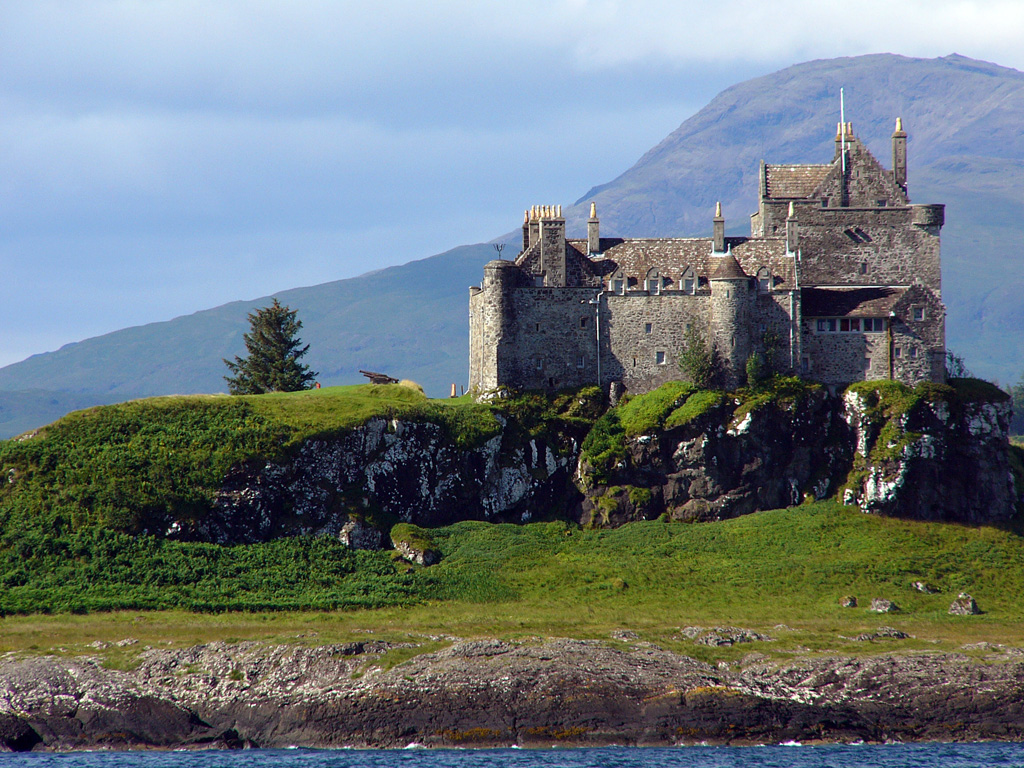
Residential rooms and service buildings stood behind the curtain wall, which had only limited openings. Three round towers were probably added by Duncan’s son Ewen. One was subsequently absorbed into the gatehouse. Look at the difference between the enclosing walls and the house rising above the entrance: their contrasting forms belong to different stages of the castle’s life.
Sources for this section · 1
02 / An older story
The Stone of Destiny and a remembered kingdom
Dunstaffnage also has a place in stories about Scotland’s beginnings. Tradition puts the Stone of Destiny here before its removal to Scone by Kenneth MacAlpin. The old Scottish Paranormal entry repeated the connection; it needs to be read as an origin legend rather than an established itinerary for the stone.
HES’s detailed assessment traces the story through early modern historians, including Hector Boece. Other sixteenth-century writers identified the legendary royal centre of Evonium with Dunstaffnage. Thomas Pennant’s eighteenth-century visit helped sustain later interest in the association.
The tale matters because it shows how people imagined the castle’s importance. Its extraordinary age in legend and the medieval dates of its surviving walls are different strands of the story. Keeping both visible lets the tradition retain its place without turning it into an archaeological finding.
03 / Power changed hands
The castle and its hereditary captains
Robert the Bruce captured Dunstaffnage after defeating the MacDougalls at the Pass of Brander. The lordship’s subsequent history passed through MacDougall and Stewart hands before the Campbell earls of Argyll gained control in the late 1460s. The castle’s keepership was entrusted to a captain, an office that became hereditary.
The Crown and the earls used Dunstaffnage as a base for western campaigns. Soldiers occupied it during the seventeenth-century conflicts and again in the Jacobite risings. This long military role helps explain why the buildings continued to change: an old fortress could still accommodate a household and serve a garrison.
The gate tower was remodelled during the late fifteenth and sixteenth centuries into a residence above the entrance. Fire gutted the gatehouse in 1810, and restoration followed in 1903–04. The roofed building seen today therefore carries several periods of work. It offers a tangible reminder that a castle’s survival often involves repair, adaptation and decisions made long after its first occupants were gone.
Sources for this section · 1
04 / Beyond the defences
A chapel with a different kind of presence
The roofless chapel stands on a small rise about 150 metres west-south-west of the castle. Built for the MacDougalls in the second quarter of the thirteenth century, it belongs to the same broad period as the fortress. Its position outside the walls gives the visit a second focus.
Notice the care in the stonework. Pink and buff sandstone dressings frame the openings, with mouldings and pointed, tooth-like ornament. The nave and chancel originally formed one continuous space beneath a timber roof. Much of the masonry survives almost to its original wall height, making the shape of the room legible even beneath an open sky.
The Campbells added a burial aisle at the eastern end in 1740. It marks another change in the use of the place, from medieval worship to family remembrance. Take time for the carved details and surviving memorials; the chapel rewards attention at a much smaller scale than the castle walls.
Sources for this section · 1
05 / A life caught in the aftermath
Flora MacDonald’s brief imprisonment
Flora MacDonald was held at Dunstaffnage for a few days in 1746 while being taken south to London. Her detention followed her part in helping Charles Edward Stuart evade capture after Culloden. It is one of the castle’s best-known personal connections.
National Museums Scotland explains that Flora assisted the prince’s crossing to Skye while he was disguised as her maid, Betty Burke. She was twenty-four. Her later account presented the decision as an act of compassion towards someone in danger. The museum describes her as an unlikely Jacobite heroine, rather than a willing supporter of the cause.
Flora returned to Scotland after imprisonment and later emigrated to America with her husband. The American War of Independence brought another upheaval before she returned to Skye. Remembering that longer life changes the emphasis at Dunstaffnage. The famous escape was a brief encounter; the woman who passed through the castle had a history that continued far beyond the prince and the songs written about him.
06 / The reported haunting
The green lady who foretells a family’s fortunes
Dunstaffnage’s best-known supernatural tradition concerns a green-clad figure called the Ell-maid. In Miriam Morris’s 2017 account for HES, she appears on the ramparts during dangerous times: a smile promises a favourable outcome, while tears warn the castle’s owners of trouble ahead. This is presented as folklore, without a dated encounter or named witness.
Scottish Paranormal’s 2012 article calls her the Scanniag or Elle Maid and connects her warnings with the Campbells. It adds stories of bedcovers being pulled away, particularly from children, and heavy footsteps disturbing the household. These details belong to the published tradition; their original testimony is not supplied.
The same entry mentions phantom soldiers and scenes apparently replaying the past, then refers to an investigation by This Haunted Land. No date, methods, witness statements or findings accompany that reference. A report containing those details remains to be traced, so the reference cannot tell us what the group recorded. The enduring image is the family’s watchful visitor, whose appearances were interpreted as messages about events still to come.
07 / Planning your visit
Allow time for the castle and the chapel
Dunstaffnage is near Dunbeg, off the A85 between Oban and Connel, postcode PA37 1PZ. Checked on 15 September 2026, HES advertises daily opening from April to September, 9.30am–4.30pm. October–March hours are 10am–3.30pm on Saturday–Wednesday, with Thursday and Friday closed. Last entry is thirty minutes before closing; the listed Christmas closure runs from 24 December to 4 January. Check the official page and book before travelling.
The main car park is 200 metres from the visitor centre along an uphill gravel track. Limited-mobility parking is closer, but the castle entrance requires 26 steep stone steps with a handrail. Further stairs lead into the gatehouse and up to the battlements. Contact the team on 01631 562 465 to discuss your route.
The chapel approach includes a rough, sometimes steep and boggy earth path. Choose footwear for the conditions and leave time for both parts of the site. From the walls to the smaller details of the chapel, the visit brings the castle’s public power and private remembrance into the same landscape.
Prepared for Scottish Paranormal / Haunted Scotland.
Sources and visitor information reviewed 15 September 2026.