
01 / The documented stronghold
Stone walls above a sea road
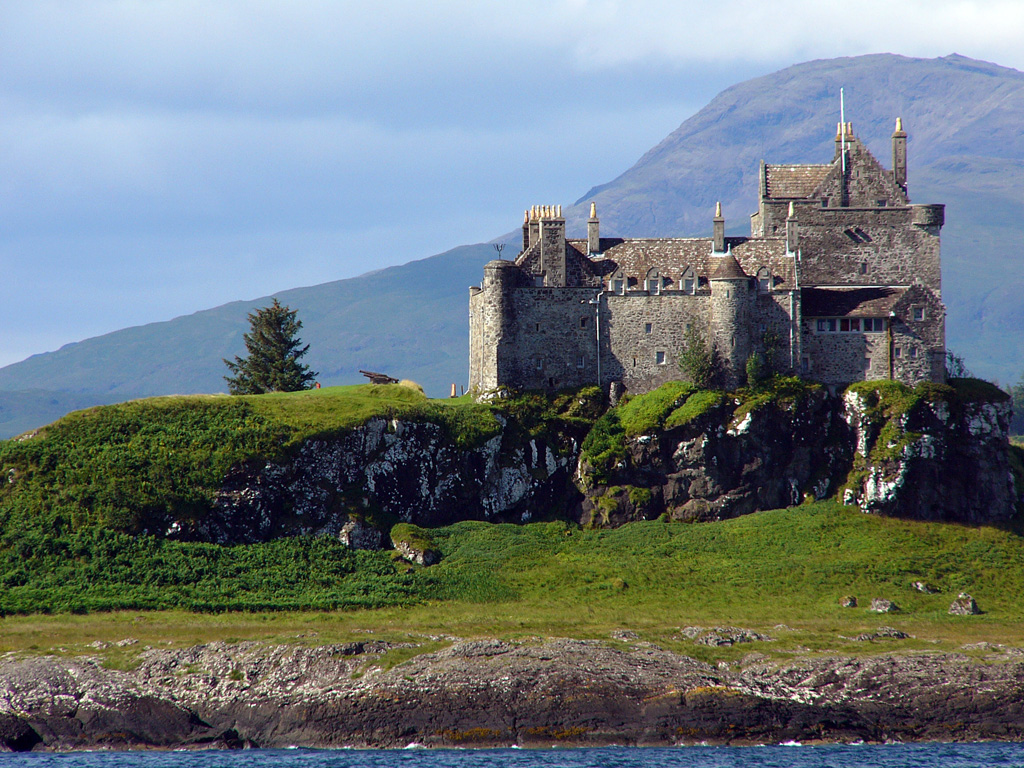
Historic Environment Scotland tentatively dates the keep to the later fourteenth century and considers the courtyard’s enclosing curtain walls earlier. Its listing describes a tall, rectangular tower with narrow openings, a hall above the kitchens and later domestic buildings fitted into the enclosure. The result is a house assembled around a strong defensive core.
The castle’s own history identifies a papal dispensation of 1367, allowing Lachlan Lubanach Maclean to marry a daughter of the Lord of the Isles, as the first recorded mention of the Macleans of Duart. That family connection placed the castle within the maritime power of the western islands.
Stand back before going inside. The abrupt rock below the walls explains something that a room-by-room tour can miss: the builders used the shape of the ground. The tower, the enclosure and the water together give Duart its commanding presence. Its architecture makes most sense with the wider landscape still in view.
02 / Loss and recovery
A family seat brought back to life
Duart’s later history was shaped by royalist loyalties, warfare and debt. The castle’s account describes General Leslie’s capture in 1647, a Maclean recovery after the Restoration and repeated changes of possession involving the Campbell Earls of Argyll. By the end of the seventeenth century, the Macleans had lost their ancestral stronghold.
Historic Environment Scotland records abandonment in 1751 and a long decline. Sir Fitzroy Maclean recovered the ruin in the early twentieth century, and architect Sir John James Burnet restored it for him. The roofed castle visitors enter today carries the work of that rescue alongside its medieval fabric.
This return changes the way the building can be read. A ruined fortress could have remained a distant landmark; instead, it became a home again. Duart’s survival includes a decision to return, repair and make rooms habitable. The family history continues beyond the battles usually attached to its name.
03 / Inside the castle
From the great hall to family photographs
The official visitor description places family portraits and coats of arms in the Great Hall, overlooking the courtyard. The Sea Room sits alongside it. These are useful places to pause after the enclosed approach: look at how the windows and thick walls frame the space, then at the people represented within it.
The State Bedroom and adjoining rooms bring the story closer to the present. The castle describes furnishings associated with a wartime honeymoon, family photographs extending from the nineteenth century onwards, and displays of uniforms and dresses. Such objects make a different kind of connection from a list of chiefs and campaigns.
At the top, the clan exhibition includes the family’s links with Scouting. Follow the displays as a sequence of changing lives. A portrait, a photograph and a garment each preserve something particular about a person; taken together, they give the imposing exterior a more intimate scale.
Sources for this section · 1
04 / The Lady Rock tradition
The tide was meant to conceal a crime
In Martin Coventry’s account, Lachlan Cattanach Maclean abandoned his wife, Catherine Campbell, chained to a rock in the Firth of Lorn, expecting the tide to drown her. She was rescued and returned to her family. The retelling links Lachlan’s later murder with revenge.
Coventry offers conflicting motives, including childlessness and an allegation of poisoning. His webpage supplies no contemporary record establishing either explanation.
The setting gives this story its power. Open water becomes a means of isolation; a woman survives the ending intended for her. Her rescue matters as much as the violence attached to the castle’s reputation.
Sources for this section · 1
05 / A haunting across Mull
Ewen’s road leads towards Lochbuie
Coventry links Ewen MacLaine of Lochbuie with Duart’s wider story, directing readers to Moy Castle. In the fuller Moy account, a family battle in 1538 ends with Ewen killed during a dispute with his father, and his horse carrying his body away.
His subsequent appearance is an omen in the tradition: a rider in Glen Mor, sometimes wearing a green cloak, whose coming anticipates a death among the MacLaines. The account belongs to Lochbuie and the landscape of Mull. It does not describe a documented apparition inside Duart’s rooms.
Keeping that geography matters. Duart and Moy are different castles, even where their family histories and stories meet. Ewen’s tale follows roads, glens and kinship beyond a single building. The published accounts used here offer no named witness or dated encounter to examine; they preserve an attributed haunting tradition, with further room for original testimony to add detail.
06 / Getting there and getting around
Plan the journey beyond the ferry
Duart is near Craignure on Mull, postcode PA64 6AP. The castle’s visitor information describes a three-mile walk from Craignure and says there is no public transport directly to Duart for arriving foot passengers. It also points to organised ferry-and-coach packages. Check the option you intend to use before committing to ferry times; local taxis are described as limited.
The access statement currently linked by the castle is dated March 2022. It describes spiral stairs, narrow corridors and uneven loose-stone surfaces around parts of the grounds. It is worth reading before booking if those features affect your visit. Contact the team about your particular needs and ask which rooms and facilities you can comfortably reach.
07 / Planning a visit
Make time for the view as well as the rooms
Checked on 15 September 2026, Duart’s published season runs from 1 April to 25 October, following an extension to its October closing date. The castle, tearoom and shop open daily from 10.30am: closing is 5pm from May through September, and 4pm in April and October. Confirm the current timetable before travelling.
Castle admission is ticketed, with tickets available online or on arrival. The grounds are free to visit, and the operator permits exterior viewing outside the building’s opening hours. Dogs are welcome in the grounds; assistance dogs are the exception to the restriction inside the castle, tearoom and shop.
Leave time at the end to look back across the water. The strength of Duart is how closely its setting, its recovered family home and its darker stories remain connected. The walls invite attention, but the view carries part of the history too.
Prepared for Scottish Paranormal / Haunted Scotland.
Sources and visitor information reviewed 15 September 2026.

