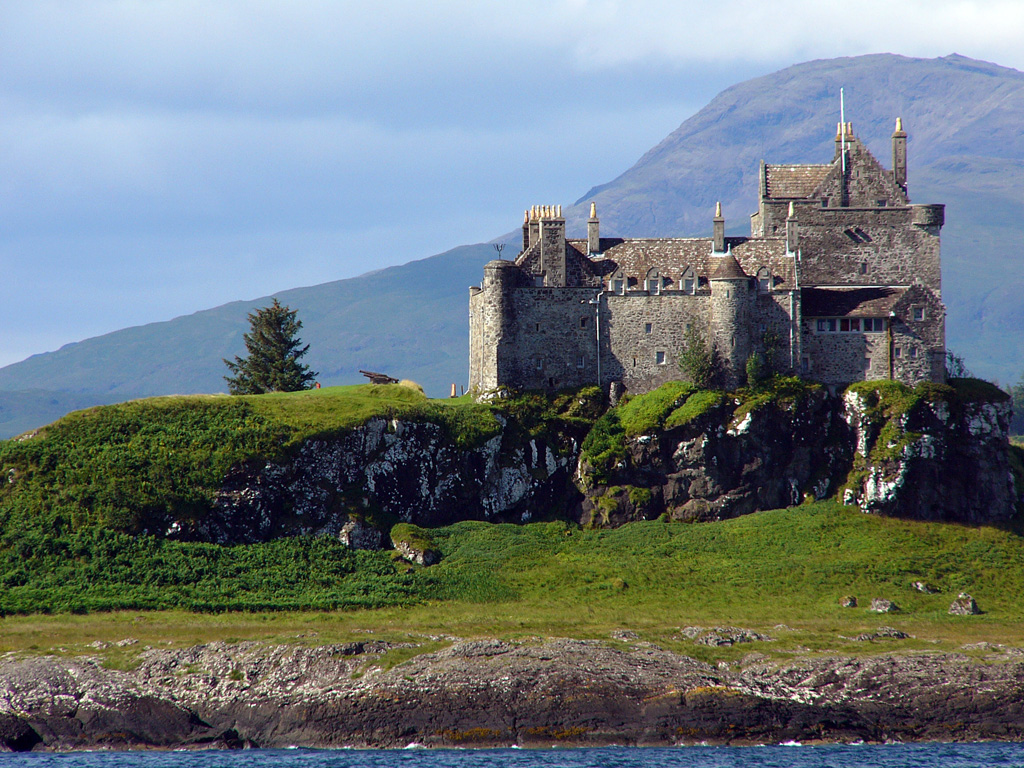
01 / The documented castle
A stronghold looking out to sea
Dunollie was a stronghold of the MacDougall lordship of Lorn. The family’s own history traces its name to Dougall, son of Somerled, and places its medieval power in the seaways and islands of the west. Dunollie belonged to a wider network of castles, including Dunstaffnage and Duntrune, associated with the family’s authority.
The standing ruin is later than the old Scottish Paranormal article’s thirteenth-century description suggests. Historic Environment Scotland assigns most of the surviving castle to the fifteenth century. A nearly square tower, roughly fourteen metres high, stands at one corner of a courtyard enclosed by a defensive wall; parts of that wall belong to later work.
Inside, the four main levels included a vaulted cellar, with one principal room on each floor. Traces of other buildings survive within the courtyard. Picture the site as a group of working spaces around a defended enclosure, with the tower rising above them. Its small footprint concentrated accommodation and protection on a naturally commanding piece of ground.
02 / Before the tower
The older Dunollie beneath your feet
The story reaches much further back than the visible masonry. The Atlas of Hillforts records references to Dunollie in early annals for years between AD 686 and 734. Excavations directed by Leslie Alcock in 1978 confirmed early medieval fortification in the earthworks around the castle.
Among the discoveries were a metalworker’s hearth and fragments of moulds for making pins, alongside weapons, tools and imported pottery. They suggest a place where people made and used things as well as defended a position. The excavation sequence included substantial stone defences and later rebuilding.
The Atlas is careful about what remains unknown: an early fort existed here, but its full shape and extent have not been established. The later castle occupies the summit, obscuring part of that earlier story. On a visit, the tower naturally draws the eye; remembering the archaeology gives equal significance to the slopes and less conspicuous ground around it.
Sources for this section · 1
03 / From fortress to family home
Life moved down the hill
The family eventually exchanged the castle for a house on lower ground. Historic Environment Scotland dates the earlier part of Dunollie House to 1746–47, with a much larger addition around 1830. The earlier building became a service wing as the new accommodation expanded beside it.
The visitor museum is known as the 1745 House. That is its established name; the museum itself describes construction in 1746. The name should not be treated as a precise completion date. Together, the house and castle make the changing expectations of a family residence visible in a short stretch of landscape.
The wider setting changed too. HES records estate improvements under Sir John MacDougall, including a walled garden planned in 1825. Its walls incorporated towers and battlemented features, giving a productive garden something of the castle’s appearance. Defensive forms could now serve a different purpose, framing cultivated ground and views rather than a medieval courtyard.
04 / Inside the museum
The things people kept
Hope MacDougall, who lived from 1913 to 1998, assembled around 5,000 objects recording ordinary life across Argyll, the Western Isles and beyond. The museum’s account places tools, textiles, photographs and household equipment alongside the better-known clan treasures. These smaller things give the visit a different intimacy after the height and exposure of the castle.
Look for the labour behind them. Butter-making equipment, baking tools and the scullery’s washboards connect a household to repeated tasks, while swords and targes bring the clan’s military past into view. Exhibits rotate, so the particular objects on display can change during the season.
Dunollie also holds a family archive whose documents begin in 1450. It includes land records, marriage contracts and Jacobite correspondence. The physical archive is not generally open to visitors, although research appointments may be arranged by request. For anyone following a family connection, that distinction is useful: a museum ticket and an archival research visit offer different kinds of access.
Sources for this section · 1
05 / The reported haunting
A piper beyond the armoury window
The old Scottish Paranormal article places a reported encounter in July 1971. Scouts had permission to camp in the grounds and visited the castle with their chief scout. One unnamed participant recalled arriving around seven in the evening and looking around what was described as the armoury.
In that recollection, six or seven people saw a piper in full Highland dress pass outside the window. Trees were visible through the partly transparent figure; his plaid was particularly noticeable. They remembered curiosity rather than fear. The article says the owner subsequently described frequent sightings and family acceptance of the apparition.
This is secondhand published testimony, with useful circumstances preserved. The scout and owner remain unnamed, and no original statement accompanies it. The excerpt does not say whether music was heard. The group sighting and family response remain reported elements of this single account, with their original documentation still to be traced.
Sources for this section · 1
06 / Planning a visit
Make time for both the ruin and the rooms
Dunollie Museum, Castle and Grounds is on the northern edge of Oban, PA34 5TT. Checked on 15 September 2026, the advertised season runs from 17 March to the end of October, Tuesday–Sunday, 10am–4pm. Mondays are closed, and the recommended last entry is 3.30pm. Check the official page for any changes before travelling.
Tickets can be bought online or at reception. The current admission scheme allows return visits during the season, so someone staying nearby can spread the museum and grounds across more than one day. Read the ticket conditions when booking and leave enough time for the whole site if this is your only visit.
Dogs on leads are welcome in the outdoor areas, including the castle and grounds, but cannot enter the museum or shop. Plan around the advertised visitor arrangements and any notices at reception.
Sources for this section · 1
07 / The climb and your route
Plan around the steepest part
The castle path climbs a steep hill and is unsuitable for wheelchairs. Dunollie’s access guidance warns that it can be slippery, particularly on the descent. A handrail and seating help along the approach. Choose footwear for the conditions and allow yourself time to come down comfortably.
The museum and other facilities offer alternatives to the climb. The operator identifies wheelchair-accessible routes from the parking area to reception, the café and museum, with an accessible toilet in the museum. Upper exhibition rooms require stairs. Contact the team on 01631 570550 or info@dunollie.org to discuss the rooms and routes you want to use.
Build the day around what suits you: the surviving tower, the collections, or time in the grounds. Dunollie’s appeal lies in how those parts belong together, each bringing a different distance from the past into focus.
Sources for this section · 1
Prepared for Scottish Paranormal / Haunted Scotland.
Sources and visitor information reviewed 15 September 2026.