01 / The documented castle
An older stronghold beneath the Gothic skyline
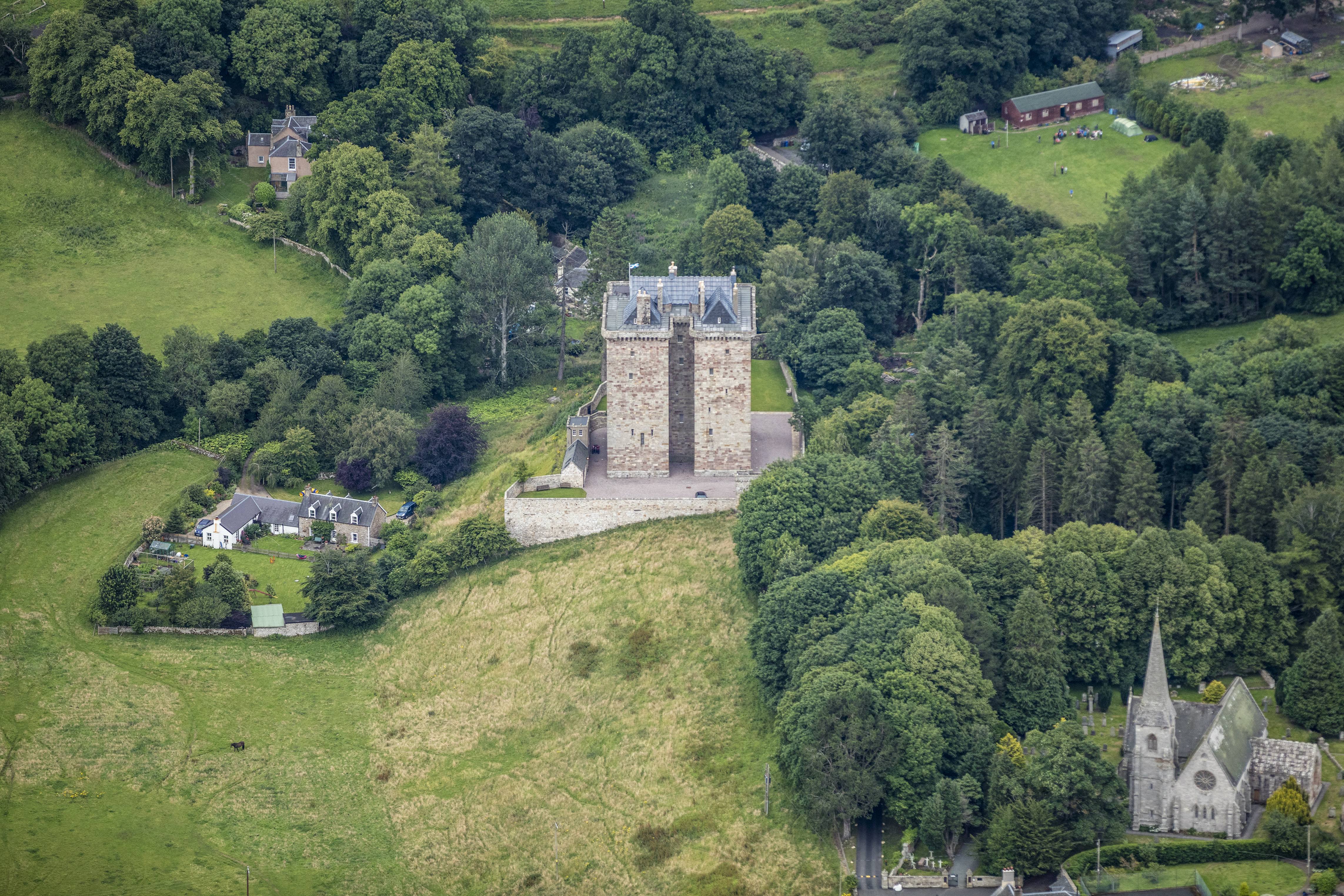
The castle’s familiar shape owes much to James Gillespie Graham’s remodelling in the early nineteenth century. Historic Environment Scotland describes four storeys, pointed windows, octagonal towers and battlemented parapets. These details turn a substantial country house into an imposing composition, with the entrance given particular emphasis.
An older tower house survives within the later building. The often-repeated date of 1320 relates to lands granted by Robert the Bruce to Thomas Randolph, Earl of Moray, and the traditional foundation of the keep. HES acknowledges uncertainty in its early history, including possible sixteenth-century destruction. The date should not be read as a secure age for every surviving wall.
Inside, HES records a richly Gothic hall and staircase, with arcades, vaulted plasterwork and sculpted details. These are part of a private interior. A view from an established estate path reveals the exterior composition; seeing the rooms requires a separate arrangement.
Sources for this section · 1
02 / A landscape made for looking
The view was part of the design
The setting was shaped as deliberately as the castle. Historic Environment Scotland traces much of the present parkland to Thomas White Junior’s plan of 1812. It softened an older formal arrangement into a landscape of open ground, woodland and carefully considered views.
Earlier features survived the change, including an artificial loch and the lime avenue. That continuity matters: the estate was repeatedly adapted, with each generation working around parts of what it inherited. The surviving maps and correspondence make those choices unusually well documented.
Duns Law gives the landscape its strongest natural landmark, rising to the east of the castle. HES records a prehistoric fort and a seventeenth-century Covenanters’ defended camp on its summit. The combination broadens the story beyond the house: a designed country estate occupies ground whose significance reaches back through several very different periods. From a permitted viewpoint, give the hill and woods some attention alongside the towers.
Sources for this section · 1
03 / The house in local memory
A building with stories in its stone
The Hay family has owned Duns Castle since 1696, according to the estate’s own account. Dunse History Society preserves a domestic tradition about an early extension: while William Hay was ill, his wife supposedly explained the building noise as work on a modest hen house. The west wing consequently became known by that name.
The same local history connects the nineteenth-century work with builder William Waddell and stone quarried at Putton Mill. It also records a claim that John Anderson’s gargoyle figures were modelled on people from Duns. That last detail belongs to local tradition; the source does not identify the individual faces.
These stories give the architecture a human scale. They invite a closer look at the relationship between the town, its craftspeople and the large house beside it. The society also points researchers towards Francis S. Hay’s family history in the Local History Room at Duns Library.
04 / A documented family loss
Alexander Hay in the surviving record
A real Alexander Hay of Nunraw died at Waterloo on 18 June 1815. National Records of Scotland publishes the inventory of his personal estate, identifying his service in the 16th Light Dragoons. This contemporary record gives the soldier’s name and death a firmer foundation than a modern retelling alone.
The document also brings the aftermath directly to the castle. On 2 August 1816, William Hay of Drummelzier made a sworn statement at Dunse Castle as Alexander’s brother and one of his executors. He confirmed that Alexander had died without a will and described taking responsibility for his affairs.
The inventory lists money owed, rents and a balance with army agents in London. Its language is practical, recording what had to be settled after a death far from home. Read beside the haunting tradition, it restores a particular person and a surviving brother to the story. It establishes the loss and family connection; the reported return belongs to a different kind of source.
Sources for this section · 1
05 / The haunting tradition
The soldier said to have returned
Duns Castle’s returned-soldier story names Alexander Hay as a soldier killed at Waterloo who nevertheless returned home. The Paranormal Database includes this tradition in an entry first added in February 2003. That is the date of the database entry, not the date of a sighting.
Its short account also mentions another figure: a teenage soldier said to linger around a building described as his former barracks. No personal name, precise room, date or witness statement accompanies that second story. The entry labels the source as published media and gives the time of the activity as unknown.
The surviving summary leaves the encounters themselves indistinct. It does not tell us what someone saw, how long it lasted or what happened immediately afterwards. The central image remains memorable: a soldier returning to a familiar place after war. Here it is retained as an attributed haunting tradition, with the circumstances of any original experiences still unresolved.
Sources for this section · 1
06 / Planning a visit
Arrange the castle before you travel
Checked on 15 September 2026, Duns Castle advertises exclusive use for weddings, private parties, corporate hospitality and stays. Its current website describes reception rooms, bedrooms and grounds used for arranged activities. Treat a visit inside as something to discuss with the estate in advance; the website does not provide a general daily sightseeing timetable.
For enquiries, contact info@dunscastle.co.uk or 01361 883 211. The address is Duns Castle Estate, Duns, Scottish Borders, TD11 3NW. Confirm the particular rooms, facilities and access you need when making arrangements, especially if steps or walking distances would affect your visit.
The estate says its main entrance is usually closed except for weddings and special events, with alternative access via Castle Street. Follow the arrival instructions supplied for your booking. An impressive gateway can be a tempting starting point, but the appropriate entrance depends on the visit you have arranged.
07 / Exploring the setting
Woodland, water and a view of the castle
For a walk, Scottish Borders Council’s Paths Around Duns booklet offers separate routes from the Market Square. Its Hen Poo and Colonel’s Walk circuit is listed as seven kilometres, taking two to three hours, over estate roads, tracks and woodland paths. It includes the two man-made ponds, Hen Poo and Mill Dam.
The shorter Duns Law route is listed as three kilometres, with steps, a climb and open ground. The booklet dates from 2007, so use it for route planning alongside current signs and conditions. Neither description establishes a fully step-free route; allow for uneven or wet ground and choose the outing that suits your mobility.
The Duns Town Trail explicitly identifies the grand lime avenue beyond Pavilion Lodge as private and says it should not be entered. Keep to the established walking routes and respect the home’s immediate grounds. The trail recommends castle views from the Duns Law path and the western approach road.
Prepared for Scottish Paranormal / Haunted Scotland.
Sources and visitor information reviewed 15 September 2026.