01 / The documented castle
An older tower held inside a later house
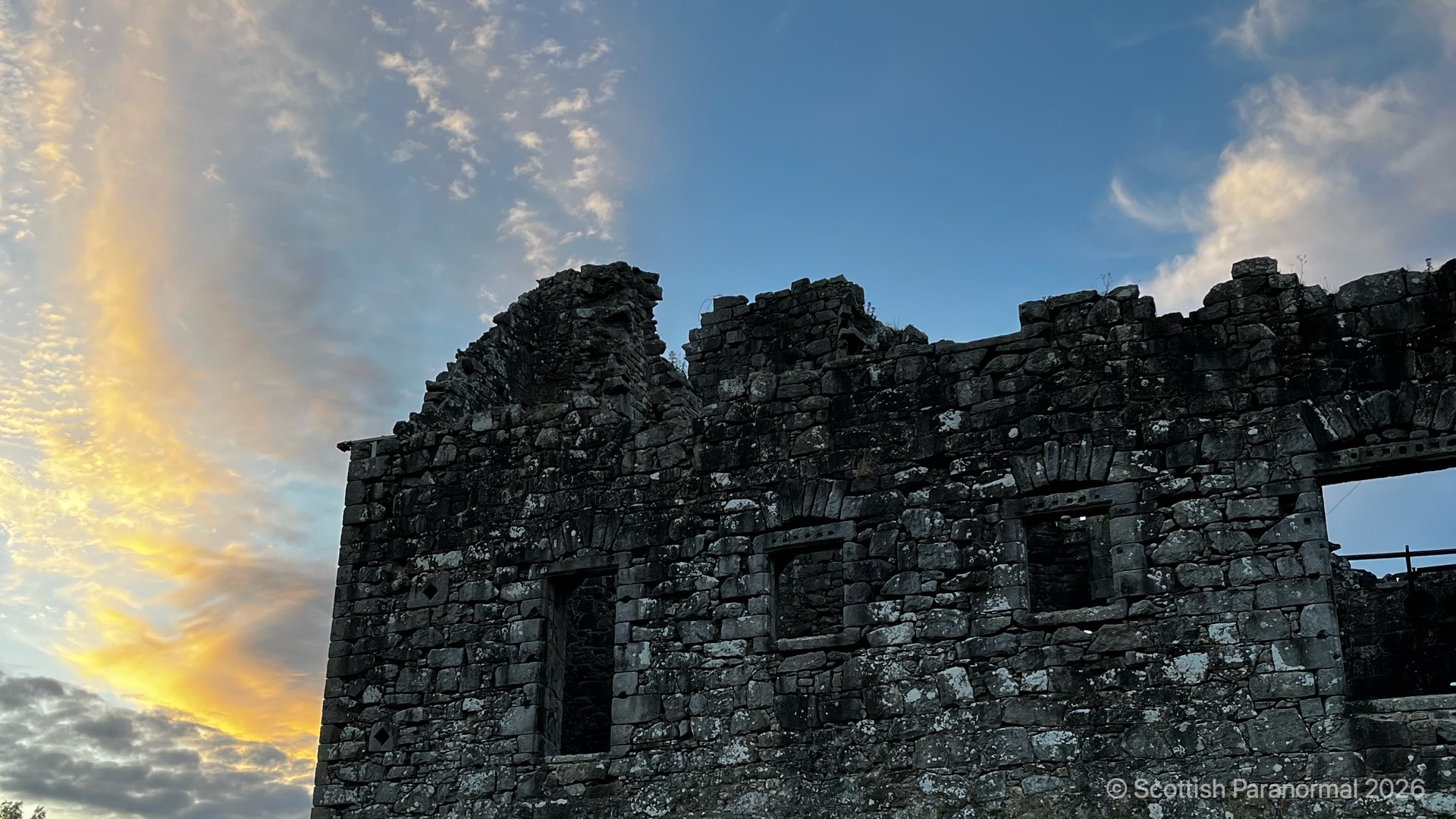
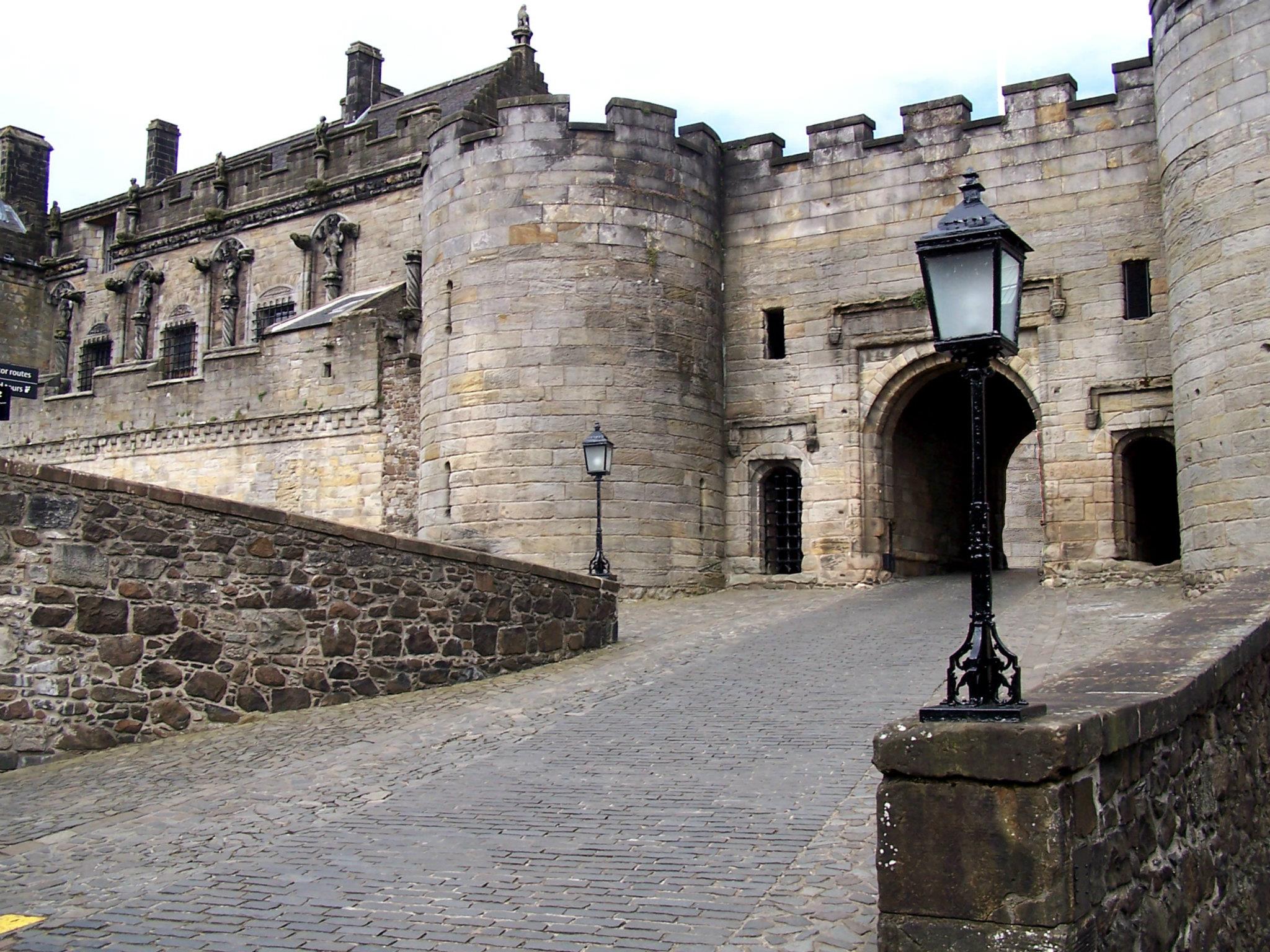
Historic Environment Scotland identifies Culcreuch as a late medieval tower integrated with an eighteenth-century mansion house. Its concise listing records stone construction, four storeys and attics, with further additions behind the tower. The building has been Category A listed since 1971.
That description offers a useful starting point for reading the exterior. The projecting stone supports below the tower’s parapet give it a different rhythm from the rows of windows in the adjoining wing. These parts belong to a building that grew as expectations of a comfortable house changed.
The surviving fabric is the strongest guide to what stands here. Early dates attached to Culcreuch in popular accounts can refer to the estate or the family’s association with it; they do not establish that every visible wall belongs to the same medieval construction campaign.
Sources for this section · 1
02 / Families and alterations
From the Galbraiths to the Napiers
Culcreuch’s association with the Galbraiths is central to its identity. The former hotel’s history describes the castle as their ancestral home before its later life as a country house. A succession of owners left a structure in which domestic alterations are as significant as defensive features.
The estate’s Napier account says Robert Napier bought Culcreuch from Alexander Seton in 1632. It identifies Robert as a son of John Napier of Merchiston, the mathematician associated with logarithms. That is a family connection; it should not be turned into a claim that the famous mathematician lived in these rooms.
The same history associates the Napiers with the enlarged front wing and records a stone over the doorway dated 1721. It acknowledges uncertainty over the wing’s precise construction date. The broader eighteenth-century dating fits the heritage listing without making the dated stone prove the completion of an entire building.
03 / Beyond the castle walls
The estate and a village of mill workers
Culcreuch’s later story reaches into Fintry. The local museum’s village history connects the growth of the settlement with a water-powered cotton mill on the Endrick Water. Housing workers changed the scale and character of a place that had earlier centred on its church and surrounding agricultural community.
The estate’s account describes the Speirs family’s investment in industry and transport, including improvements to the Crow Road across the Campsies. It also records dams and a mill lade: the channel carrying water towards the machinery. The mill’s operation depended on a managed landscape as well as a large building.
This gives the castle another context. The fortunes of a country house could be tied to workers’ homes, roads and water power beyond its grounds. Reading Culcreuch alongside Fintry helps restore those connections, which can disappear when the story stays entirely with the owners and their rooms.
04 / Inside the old house
Birds on the walls and vaults below
The Chinese Bird Room supplies one of Culcreuch’s most distinctive images. The former hotel’s history places it on the second floor of the old tower and dates its hand-painted Chinese wallpaper to 1723. That date is the venue’s published attribution; this guide has not independently dated the paper.
Below it, the same account describes two barrel-vaulted basement cellars that became the Dungeon Bar and dining space. The large room on the first floor was the Laird’s Hall, later adapted for meals and gatherings. These remembered hotel uses explain many of the room names in accounts of alleged activity.
These hotel-era descriptions show older spaces given new purposes. They do not establish that the rooms can currently be entered or booked.
Sources for this section · 1
05 / The Phantom Harper tradition
A lament that outlasts its player
Martin Coventry’s published Culcreuch account places the Phantom Harper story in 1582. In his version, a Buchanan is mortally wounded by Robert Galbraith and taken into the room now called the Chinese Bird Room. His mistress accompanies him and plays a wire-strung harp after his death.
The tradition says that the music returns at night, heard in that bedroom, its neighbour and the Laird’s Hall. It is an intimate haunting: the memory of someone keeping company with a dying lover, expressed through a sound rather than a visible figure.
Coventry presents the encounter as a reputed story. His short account does not supply a contemporary record of the killing or a dated statement from someone who heard the music. The setting and names belong to the published tradition; the details of the death and the cause of any later sound remain unestablished here.
Sources for this section · 1
06 / A dated investigation account
Shadows at a door, and a reading explained
The Ghost Club investigated Culcreuch on 29 January 2005. Derek Green compiled its report from the team’s notes, covering the Chinese Bird Room, dining room and Dungeon Bar.
During the final bedroom vigil, Chris De Rosa and James Keenan reported a moving shadow resembling feet in the light beneath the door. They approached, opened it and found the corridor empty. The report preserves what they believed they saw; it does not establish what produced the shadow.
It also records a practical explanation. An electromagnetic reading initially associated with a wardrobe was traced to the shower unit behind the adjoining wall. Trigger objects checked before midnight showed no recorded movement.
These details belong together. A dated account can preserve an unusual observation while retaining ordinary explanations and negative findings from the same night. The report is the Ghost Club’s work, with its investigators’ interpretations; it is not an HSI investigation or independent proof of a haunting.
Sources for this section · 1
07 / Planning around current access
Check the castle’s status before making a journey
Culcreuch is near Fintry in the Stirling area. On 15 September 2026, the former hotel’s official homepage still displayed the owners’ announcement of closure from January 2020 for restoration. The same page retains older hospitality and booking material. Those surviving links do not establish that the hotel has reopened.
No current public-admission programme or confirmed reopening date was established in the sources checked for this guide. Treat accommodation, restaurant visits and interior access as unconfirmed, and obtain a current answer from the property before arranging a visit around them.
The castle and the wider estate are different access questions. This guide does not establish a walking route, permission to use the former hotel car park or entry to the building. If exploring the Fintry area, use current local route information and respect signs and private residential areas. Culcreuch can remain part of the area’s story without a promised interior visit.
Sources for this section · 1
Prepared for Scottish Paranormal / Haunted Scotland.
Sources and visitor information reviewed 15 September 2026.