01 / The documented castle
An old name, a sixteenth-century tower
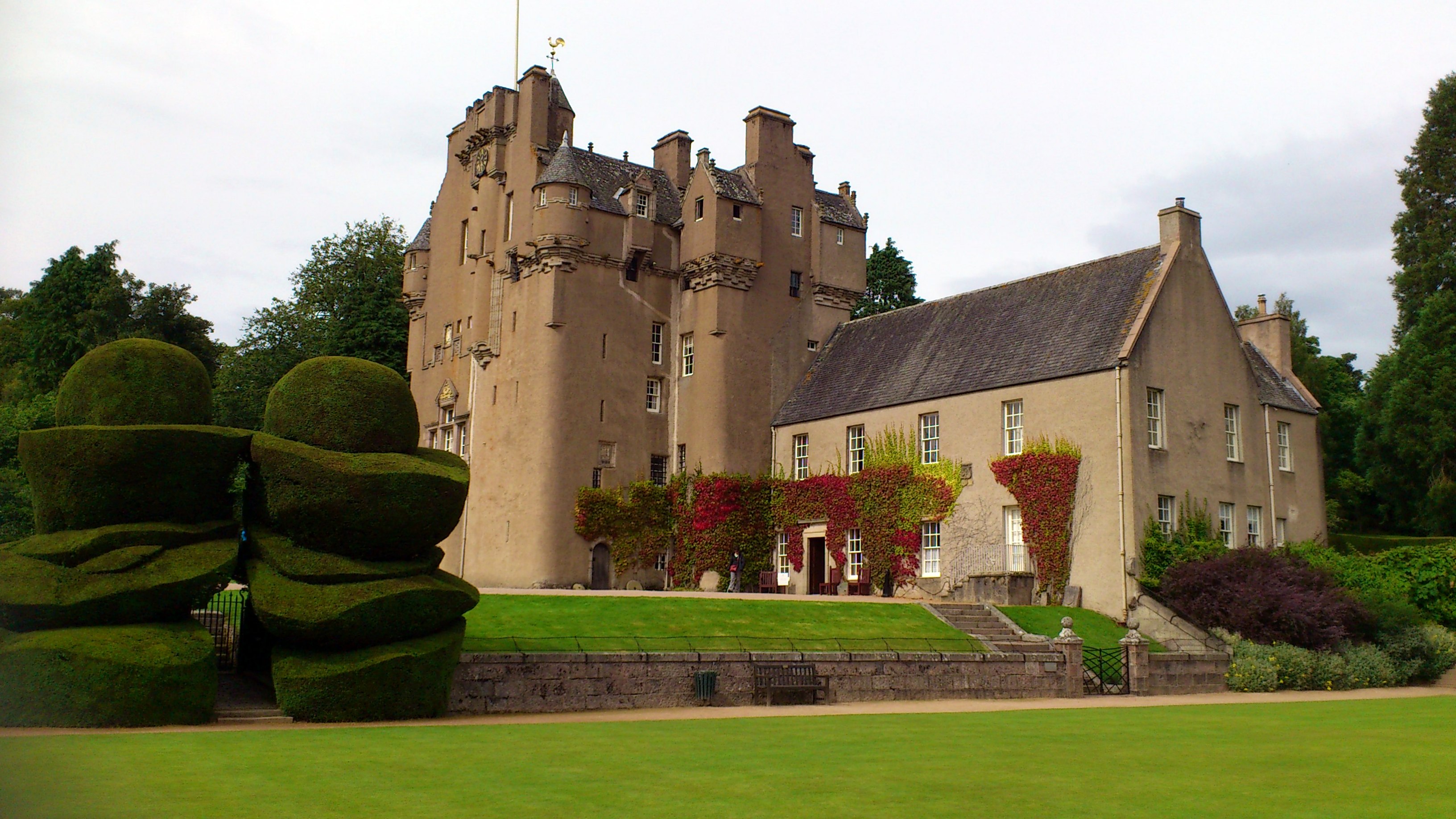
Historic Environment Scotland dates Delgatie’s standing L-plan tower house to 1570–79. Its protective harling, projecting corner turrets and stepped gables give it a strong presence above the lower buildings. The Category A listing recognises a much-altered house whose principal form still belongs to the sixteenth century.
The Castle Trust places its beginnings much earlier, giving dates around 1030 and 1049 on its website and about 1100 for the main tower. Those claims should be read as the castle’s account of its origins. They do not establish that the walls visible today survive from the eleventh century.
The building rewards looking at individual parts. A tower, an added window and a decorative wing need not tell the same story or belong to the same century. Delgatie’s interest lies partly in the way successive owners made an imposing older structure suit changing ideas of a home.
02 / Inside the house
A painted world above your head
The heritage record describes vaulted rooms and a circular turnpike stair: the broad spiral around which movement through the tower is organised. It also records painted ceilings from 1597. These are among the details that make the interior more than a sequence of furnished rooms.
The Landmark Trust’s historian Caroline Stanford explains how Scotland’s Renaissance painters transformed plain joists and boards with colour, emblems and moral sayings. At Delgatie, she dates the Rohaise Room ceiling to 1597 and notes the initials JM, thought to refer to Aberdeen painter John Melville. The identification remains an attribution.
When the Landmark Trust restored Fairburn Tower, Delgatie’s ceiling supplied a model for a newly commissioned design. Stanford connects this decorative language with widely circulating pattern books and the fashion for images that carried proverbial or cautionary meanings. Look at a painted figure as something intended to be read as well as admired. A small motif can hold a thought that its original audience would have recognised.
03 / A family home recovered
The Hays leave, and return
Clan Hay’s own history says Delgatie came to the family through marriage to a Fraser heiress in the fifteenth century. It later passed to the Earls of Erroll and then to unrelated owners. That account complicates the appealing idea of one family living here continuously across the centuries.
The twentieth-century return became an act of preservation. The heritage listing records the Countess of Erroll’s repurchase in 1948 and Captain John Hay’s restoration from 1951. Clan Hay describes the rest of his life as devoted to the castle, which now serves as its official centre.
The Castle Trust says John and his wife Everild wanted Delgatie to retain the character of their home. That intention offers a useful way to approach the visit. Look for the relationship between grand architecture and the more personal feeling of rooms people chose to repair, furnish and continue using. Survival here depended on care sustained over years.
04 / Royal connections
A queen’s remembered stay, a king’s attack
The Castle Trust associates a bedchamber with Mary, Queen of Scots, and says she stayed for three days following the Battle of Corrichie in 1562. Martin Coventry’s Castles of Scotland repeats the visit. Neither webpage supplies a contemporary itinerary or document for those three days, so the guide retains it as an attributed royal association.
Coventry also describes a harsher encounter with royal authority. In 1594, Francis, ninth Earl of Erroll, supported the Earl of Huntly against James VI; the king’s forces damaged Delgatie’s west wall. Political allegiance could turn a family seat into a target.
These two accounts give the rooms different associations: hospitality offered to a queen and a house exposed to armed conflict. The named bedchamber is part of how Delgatie presents its past; its furnishings alone cannot establish who slept there centuries earlier.
05 / The bedroom tradition
Rohaise, the woman said to remain
Delgatie’s best-known ghost tradition centres on Rohaise. In Coventry’s telling, she is a young woman believed to have defended the castle during an attack. Her haunting is associated with the bedroom bearing her name, off the main stair, where she is said to visit men who stay overnight.
VisitAberdeenshire describes her as red-haired and repeats the connection with male occupants. The image is unusually personal: a remembered defender of the house whose presence belongs to one particular room. The story gives the bedroom an identity that reaches beyond its furniture and painted ceiling.
These published retellings provide no named witness, date of an encounter or contemporary record establishing Rohaise’s identity. They preserve a tradition with a recognisable setting. If the room feels affecting, there is space to acknowledge that response without deciding immediately what caused it. The experience of a place and the explanation attached to it are questions that can be considered separately.
06 / The wartime story
Soldiers in an unfamiliar house
The Castle Trust records soldiers using Delgatie as temporary barracks during the Second World War. VisitAberdeenshire adds a dramatic ghost story: a military unit supposedly fled barefoot after being pursued by the spirit. That detail belongs to its Halloween collection of local tales.
The tourism account does not identify the unit, soldiers or date, and offers no military record or witness statement. Wartime occupation and the reported flight therefore have different foundations. One provides the historical setting; the other is a story told about what allegedly happened within it.
The image of soldiers hurrying out of a castle is memorable precisely because it reverses expectations about who might be frightened. It can be enjoyed as storytelling while leaving its details open to further research. A named witness or dated record would add something that repeated summaries cannot supply.
07 / Planning a visit
Make time for the rooms and the tearoom
Delgatie Castle is at Delgaty, near Turriff, Aberdeenshire, AB53 5TD. Checked on 15 September 2026, the Castle Trust advertises public opening every day from 10am to 4pm. Its home page gives the same daily hours for the Laird’s Kitchen tearoom, serving drinks, baking, lunches and afternoon teas.
Confirm arrangements directly before travelling, particularly around holidays or events. The Trust’s contact number is 01888 563479. Ask about admission, the rooms available that day and any individual access needs; the historic stair is central to the tower, and this guide has not established a complete step-free visitor route.
Allow enough time to pause beneath the painted ceilings. Their details are easy to hurry past while moving between rooms or listening to a story. A good visit can hold all of Delgatie’s different qualities together: a striking tower, a repaired family home, an extraordinary decorative survival and a bedroom whose name continues to carry a mystery.
Prepared for Scottish Paranormal / Haunted Scotland.
Sources and visitor information reviewed 15 September 2026.