01 / The documented castle
A new home after a royal reckoning
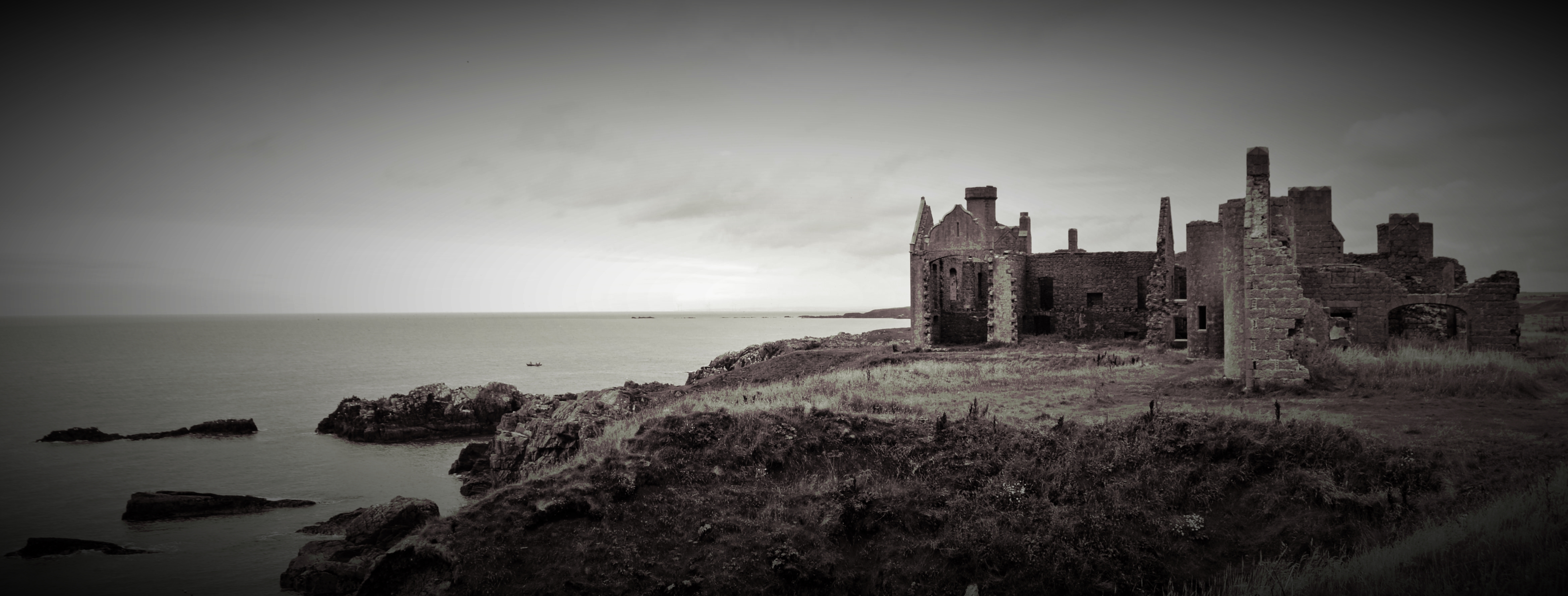
The word ‘New’ matters. Old Slains stood farther south, near Collieston. After James VI destroyed that castle, the ninth Earl of Erroll established another residence at Bowness, above the coast at Cruden Bay. Aberdeenshire Council dates its beginnings to the late sixteenth and early seventeenth centuries.
The new house grew around a tower and courtyard. Successive generations altered the building, and a major reconstruction in 1836–37 gave it much of its later appearance. Garden earthworks remain in the surrounding landscape, recalling the designed grounds that once accompanied this substantial family home.
Sources for this section · 1
02 / Reading the building
A country house with a castle’s silhouette
Historic Environment Scotland identifies John Smith as the architect of the nineteenth-century remodelling. Pink granite, Tudor details and new service buildings transformed an older residence. Behind the imposing exterior were nurseries, bedrooms, kitchens and workshops: the everyday machinery of a large household.
The Hay family sold the castle in 1916. Its roof was removed in 1925, along with other valuable fittings and stonework. The ruin’s open sky belongs to this later chapter. When imagining Stoker’s visits to the area, picture an inhabited mansion rather than the roofless building familiar today.
Sources for this section · 1
03 / A visitor’s account
The sea kept Boswell awake
On 24 August 1773, James Boswell and Samuel Johnson arrived as the dinner bell rang. Boswell describes hospitality, children, books and prints. A gallery gave the family a sheltered walk and allowed people to reach their rooms without passing through one another’s private space.
That night, a blazing fire, the roaring sea and the smell of his feather pillows delayed sleep. His thoughts turned to the Earl’s father, Lord Kilmarnock, executed in 1746. Boswell explicitly places that image in his imagination. It is a wonderfully atmospheric passage, and a reminder to let an old witness describe his own experience without turning it into a ghost sighting.
Sources for this section · 1
04 / Literature and landscape
How close is Slains to Castle Dracula?
Bram Stoker repeatedly holidayed in Cruden Bay. The University of Aberdeen’s Elphinstone Institute describes the surviving hotel guestbook signatures and the local cottages associated with his stays. His connection with this coast extends beyond Dracula: The Watter’s Mou’ and The Mystery of the Sea use the surrounding landscape directly.
The most intriguing architectural link is an octagonal room. In an interview with Starburst, Dacre Stoker explains why he believes Slains supplied a model for the room described in Dracula’s second chapter. That gives readers a specific connection to explore, while leaving room for the many other influences on the novel.
The walking guide hosted by the Bram Stoker Estate makes that distinction explicit. It also acknowledges that direct evidence of Stoker entering Slains has not been established, despite the family tradition that he was invited. The Rosenbach Museum’s surviving notes and outlines date from around 1890–1896: Dracula developed over years. Slains’ possible influence on its imagery remains compelling, without a claim that Stoker wrote the book inside these ruins.
Sources for this section · 4
- University of Aberdeen, Elphinstone Institute — Bram Stoker and Cruden Bay, pp. 2–4 (opens in a new tab)
- Starburst — The Blood Is The Life: An Interview With Dacre Stoker (opens in a new tab)
- Bram Stoker Estate — Bram Stoker and Cruden Bay: A Walking Guide, Slains discussion (opens in a new tab)
- The Rosenbach — Guide to Dracula and vampire-related holdings (opens in a new tab)
05 / The haunting accounts
Keys in the corridors
In his June 2019 account for Spooky Isles, Ryan O’Neill records stories shared by Haunted Scotland and Scottish Paranormal group members: a figure associated with jangling keys and a tug at a jacket; apparitions described as soldiers; a woman in white; a horse and carriage approaching the entrance.
These are reported experiences preserved in our earlier coverage. Their witnesses, dates and circumstances are not individually documented in that article. The proposed identities need a separate enquiry. Calling the key-carrying figure a jailer, or linking the woman to people accused of witchcraft, requires historical records that the article does not provide.
The stories remain worth hearing. Keeping the encounter distinct from its proposed explanation gives us a clearer starting point for research, and room for witnesses to tell us more.
Sources for this section · 1
06 / From our film archive
Listening inside the empty house
Our fourteen-minute film, Haunted Castle - Scotland’s Scariest Places, was published on 28 May 2019. It combines the location’s stories with an evening of joint investigation. Ryan’s accompanying article describes sessions involving seven paranormal teams, including one from South Australia. Publication dates identify the archive; they do not establish the date of every session shown.
Haunted Scottish Castles | Dracula Inspired, published on 1 November 2020, offers a longer, twenty-five-minute exploration. Ryan and Greg discuss sounds they perceive above them despite the missing floors. Their closing conversation returns to loud bangs, a felt vibration and the persistent impression of being watched.
There are valuable moments of uncertainty too. During the walk, possible sounds are considered against the sea and an animal. The film introduces a scanning radio device and acknowledges that radio material can come through. Those conditions matter when interpreting a sound or a phrase.
Watch the films as records of the team’s experiences and developing interpretations. The cause of the reported sounds remains unresolved here; this guide does not identify a spirit from an edited audio sequence. A fuller assessment would need the original recordings, exact timings and checks on other people, equipment and environmental sounds.
Sources for this section · 3
07 / Plan a visit
Enjoy the coast from the paths
Aim for New Slains at Cruden Bay, not Old Slains near Collieston or the Slains Castle pub in Aberdeen. The local Cruden Bay guide describes walking approaches from the village and the small A975 parking area. Vehicles should not continue along the track to the ruin.
Plan an exterior visit. The walking guide hosted by the Bram Stoker Estate warns that the ruin is unsafe to enter because of falling masonry and dangerous stairs. VisitAberdeenshire advises keeping to surrounding paths, away from cliff edges, and avoiding climbing the structure.
Check current local notices and weather before setting out. Uneven ground, exposed paths and unguarded drops demand care. Our older films show past investigations; they are not a guide to safe access today. Visitor guidance was reviewed on 15 September 2026.
WATCH / HAUNTED SCOTLAND
Return with the team
Follow the investigation through these films. Listen in context, then return to the account above to compare the observations and interpretations.
BEGIN WITH THIS FILM
Haunted Scottish Castles | Dracula Inspired
A longer exploration with Ryan and Greg, reported sounds and the team’s on-site discussion.
Film published 1 November 2020 · 24:54Haunted Castle - Scotland's Scariest Places
Our New Slains introduction and joint investigation, linked from Ryan’s June 2019 article.
Film published 28 May 2019 · 14:28Watch on YouTube ↗ (opens in a new tab)Prepared for Scottish Paranormal / Haunted Scotland.
Sources and visitor information reviewed 15 September 2026.