01 / The vanished stronghold
Reconstructing a castle from its absence
The doocot stood apart from the castle, roughly 150 metres to its north-east. Historic Environment Scotland’s account reconstructs the lost stronghold from older descriptions and views: a tower, an enclosing defensive wall, round corner towers and a moat. Those records give us an outline to imagine while walking through a landscape that has changed almost completely.
The exact chronology of the castle’s disappearance is less clear. HES places fire and substantial demolition in 1790 in its chronology, while elsewhere describing demolition in the nineteenth century. The secure conclusion is that the residence vanished as its estate was divided and developed.
The doocot is therefore a surviving estate building, not a remnant of the castle’s defensive tower. Its separate purpose explains why this compact structure can still tell part of the story after the larger building has gone.
02 / The family and the village
A castle for security, a church for remembrance
The Old Parish Church’s history traces Adam Forrester’s purchase of Corstorphine to 1374, supported by a confirmation charter of 1376. He established his castle between what are now Dovecot Road and Castle Avenue. Nearby, he also founded a chapel dedicated to St John the Baptist, where prayers and masses would be offered for his family.
After Adam’s death, his son John enlarged the chapel. It developed into a collegiate church, served by a body of priests under a provost. The church’s account dates that foundation to 1429 and papal recognition to 1444. Its history joins two ambitions familiar in medieval lordship: securing a family’s possessions and securing its remembrance.
The present Old Parish Church retains Forrester tombs among its historic features. It gives the castle story a human scale. The family who occupied the vanished residence also left a place where names, memorials and worship carried their presence forward.
Sources for this section · 1
03 / The building that survives
A stone house for a thousand nests
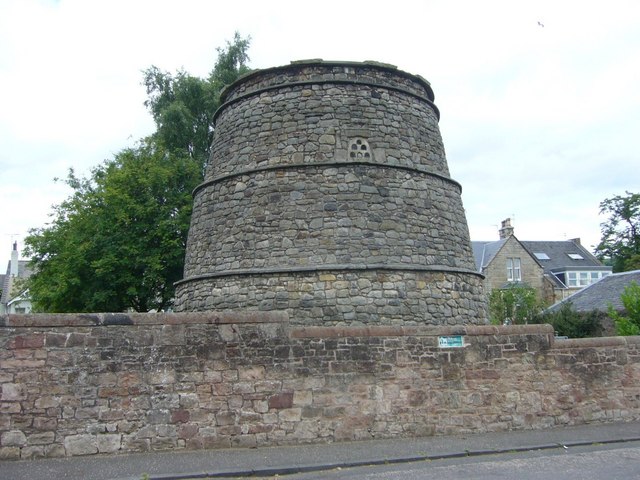
The dovecot belongs to the sixteenth century. Its Category A listing describes three circular stages built in sandstone rubble, with projecting bands separating the levels and a shallow stone roof. Above one band, an arched arrangement of flight holes admitted the birds. The low human doorway sits on the opposite, northern side.
Inside are 1,060 stone nesting boxes. The listing also records walls three feet ten inches thick and a socketed stone for the central pole of a potence, the rotating arrangement used to reach nests. Although today’s visitor access is exterior only, those details help explain how much working space was packed into the round shell.
HES explains that the young pigeons, or squabs, supplied dependable fresh meat. A doocot also displayed its owner’s standing. Look at the heavy masonry and repeated ledges with both uses in mind: a practical food supply, built prominently enough to make an impression.
Sources for this section · 3
04 / The historical tragedy
Christian Nimmo and Lord Forrester
In August 1679, James, Lord Forrester was killed by Christian Nimmo. James Grant’s nineteenth-century Old and New Edinburgh places their confrontation in the castle garden, at a tree near the pigeon house. It describes Christian as a married woman and the niece of Forrester’s first wife, with whom he had an affair.
Grant’s account carries several layers of older testimony. He draws on Fountainhall for the killing and records Christian’s claim that she took Forrester’s sword when he threatened her. The same account rejects her defence. This is an inherited narrative of a prosecution, with strong judgements about her character; it cannot give us an unmediated view of the encounter or her thoughts.
Grant records her execution at Edinburgh’s market cross on 12 November 1679, following an escape and recapture. The deaths form the historical centre of Corstorphine’s later ghost story. The argument’s exact course, and the motives assigned to it, need more care than a simple tale of a jealous lover.
05 / The haunting tradition
A white figure beside the pigeon house
Grant preserves a striking piece of local folklore through Charles Kirkpatrick Sharpe’s notes to Kirkton’s history. Villagers, it says, had been troubled on moonlit nights by a woman dressed in white, wandering and lamenting near the pigeon house with a bloodied sword. The building standing today is therefore central to the older telling, rather than a convenient modern backdrop.
The apparition became known as the White Lady and was identified with Christian Nimmo. The tradition remains visible in the name and published history of The White Lady pub on St John’s Road. That account connects her to a sycamore which survived until the storms of 1998, long after the castle had gone.
The older passage offers no named witness, dated encounter or conditions that would allow an individual sighting to be examined. It establishes that the story circulated, while leaving the reported experiences unresolved. Its power lies in a simple image: an ordinary estate building, a vanished garden and a figure apparently unable to leave.
06 / Following the remaining clues
The castle’s story stays in the village
The Corstorphine Trust’s Dower House offers another connection with the lost estate. Its account cites J P Wood’s 1792 draft parish history, which describes stone being removed from the old castle site for another residence associated with the Forresters. It is a reminder that a demolished building can continue through reused material as well as through stories.
The Trust received use of the derelict Dower House in 1991 and restored it with outside support. In 2000 it adopted the name Corstorphine Heritage Centre. Its crow-stepped gables and limewashed exterior belong to another strand of village history. For a fuller exploration, use the Trust’s own information to check opportunities to see its local collections and learn about the surrounding streets.
Sources for this section · 1
07 / Planning a visit
Begin with the doocot exterior
Historic Environment Scotland currently lists Corstorphine Dovecot as free to visit throughout the year, with exterior viewing only. The official address is Dovecot Road, Edinburgh, EH12 7LF. Use that landmark when planning a journey: there is no standing Corstorphine Castle to enter.
A short exterior visit is enough to appreciate the curved walls, projecting ledges and flight holes. Combine it with an exploration of the old village if time allows, checking the church and Heritage Centre separately for any interior access. Keep to the visitor approach and public streets around the surrounding homes.
The official visitor page links to a public-transport journey planner. Recheck its current notices before setting out, and contact HES if you need detailed information about access surfaces or mobility requirements. These arrangements were checked on 15 September 2026.
Sources for this section · 1
Prepared for Scottish Paranormal / Haunted Scotland.
Sources and visitor information reviewed 15 September 2026.