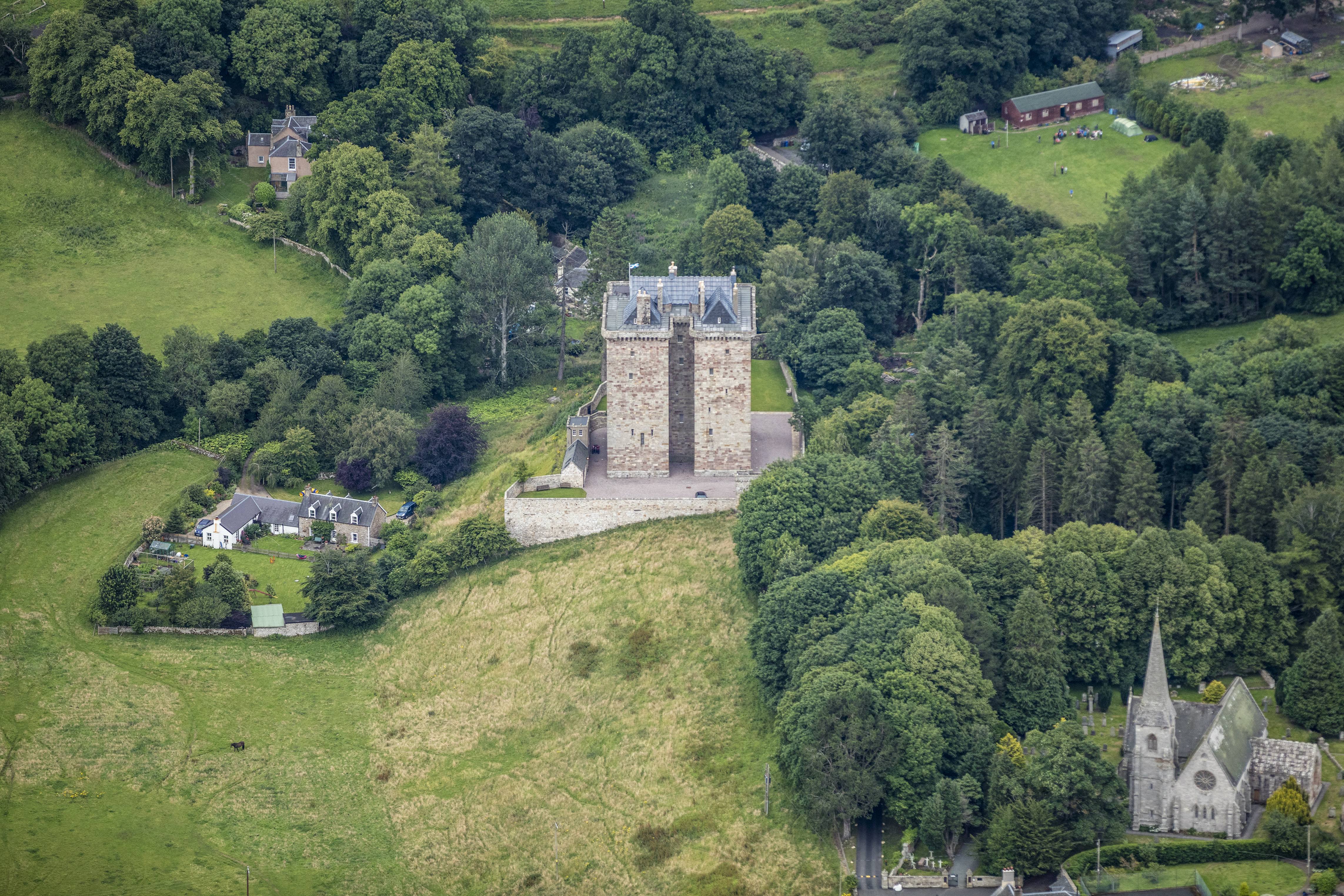
01 / The documented castle
Old foundations, a Victorian silhouette
The first castle here is associated with the Mowbrays, a Norman family, and the thirteenth century. Ownership passed to Sir Thomas Hamilton in 1615 and subsequently to the Primrose family, whose descendants became the Earls of Rosebery. Those medieval beginnings should be distinguished from the building in the photograph.
Historic Environment Scotland dates the present house to 1881, designed by James Maitland Wardrop of Wardrop and Reid, incorporating earlier fabric. Three storeys and an attic rise from a projecting rock terrace. Stepped gables, battlements and small turrets give it the fortified appearance favoured in Scottish Baronial architecture.
Inside, the listing records a tall library with an oak gallery, a carved fireplace and a timber ceiling rising through two storeys. A seventeenth-century obelisk sundial stands outside. These details reveal a place assembled across different periods: an older coastal stronghold transformed into a richly finished house. Its current listing is Category A.
Sources for this section · 1
02 / Plans and changing fortunes
The castle that stayed on paper
Barnbougle might have looked very different. In 1774, Robert Adam prepared designs for Neil Primrose, the 3rd Earl of Rosebery. His proposal placed the existing tower at the seaward tip of a triangular building, with an elaborate skyline spreading behind it. The surviving drawings are held by Sir John Soane’s Museum and the Rosebery collection.
Family tradition linked the commission to the Earl’s courtship of Mary Vincent. The museum’s catalogue discusses the suggestion that these were impressive drawings made to catch her eye, while emphasising that the evidence is inconclusive. What is certain is that Adam’s scheme was never built.
By 1814, the old castle was badly deteriorating. Dalmeny House, completed in 1817, replaced it as the principal family residence. The museum records partial destruction in an accidental explosion in 1829; the remains then became a picturesque ruin in the grounds. The 1881 rebuilding gave those remnants an entirely new purpose.
Sources for this section · 1
03 / A scholar’s retreat
Six libraries and one bed
The man behind that transformation was Archibald Primrose, 5th Earl of Rosebery. He later served as Britain’s prime minister from 1894 to 1895, but Barnbougle offered space for the quieter interests that accompanied his public life. Books and conversation shaped the house he commissioned.
Rosebery Estates describes a retreat containing six libraries and a single bed. There were comfortable rooms for meetings, while the gallery in the banqueting hall gave the Earl somewhere to practise speeches. It is an unusually personal brief for a castle: shelves, a place to think and enough space to try out an address before delivering it elsewhere.
After his death in 1929, the building and furnishings were largely retained as he had known them, according to the estate’s history. Modern facilities have since supported its use for events. The library setting still helps explain its character, while the sea-facing terrace and great hall now frame celebrations rather than a statesman’s rehearsal.
04 / The nineteenth-century account
A bugle from the shore
In Summer Life on Land and Water at South Queensferry, published in 1851, William Wallace Fyfe describes Hound Point and introduces an old local legend. Before a lord of Barnbougle dies, a figure accompanied by a hound is said to appear on the headland and sound a warning on a bugle. Fyfe gives no named witness or dated occurrence for this account.
He then turns the tradition into verse. His Sir Roger Mowbray prepares to sail on crusade, sees his dog’s distress and promises that they will remain together. Knight and hound board the boat. Later, a bugle sounds by the castle and a supernatural figure appears beside a hound in the ebbing tide, announcing death in the household.
Fyfe explicitly introduces the poem as an imaginative response to the setting and story. It is a valuable nineteenth-century source for the tradition, rather than a contemporary record of a medieval expedition. The loyal animal gives the tale its emotional centre; the horn carries news that the household cannot yet know. The original text is linked below for readers who want to follow its full development.
05 / How the story changes
Did the hound stay or sail?
The dog’s journey changes between retellings. Rosebery Estates’ history has Roger de Moubray’s hound remaining at Barnbougle and howling when its master dies in battle. A version by William Hendrie, reproduced by Queensferry History Group from Discovering West Lothian, instead has the animal leap aboard the departing ship and accompany its master overseas.
Hendrie’s account places the returning hound on the winter shoreline, searching for its lost companion. Sometimes a white-robed warrior accompanies it, understood within the story as a warning of death in the owning family. Fyfe’s version gives the bugler the central warning role; other versions depend chiefly on the dog’s cry.
These are variations of a shared local tradition. They do not become separate witnessed incidents simply because several websites repeat them. The sources reviewed here provide no named, dated first-person encounter to set alongside the legend. That leaves a clear starting point for future research: who heard or saw something, where they were and how their experience was recorded.
Sources for this section · 3
06 / Current access
Arrange access with the venue
Barnbougle operates as an exclusive-use venue for private events, meetings and weddings. Its current official FAQ expressly says that the castle is not open to the general public. It also confirms that there is no overnight accommodation within the castle itself. A coastal walk or an old photograph should not be taken as permission to enter the building, terraces or event grounds.
If you are attending an event or arranging a venue visit, obtain directions and gate arrangements from the events team. The estate advertises a ramp at the main entrance, a lift serving all levels and a wheelchair-accessible toilet on the ground floor. Gravel and mixed surfaces can make the approach uneven, and the private beach has narrow steps; discuss the route you need before travelling.
The official website’s gallery offers a useful look inside the present venue. Our exterior photograph dates from August 2007 and shows the castle from the west. Access information was checked on 15 September 2026; confirm arrangements directly when planning a visit.
Prepared for Scottish Paranormal / Haunted Scotland.
Sources and visitor information reviewed 15 September 2026.