01 / The documented castle
A tower built up over generations
The family’s connection with this land reaches back to 1454, when James II granted Thomas Fraser the barony of Muchall. Historic Environment Scotland cautions that it is unclear whether a house already stood here or the new laird built one. A land grant and a building’s birthday need not be the same thing.
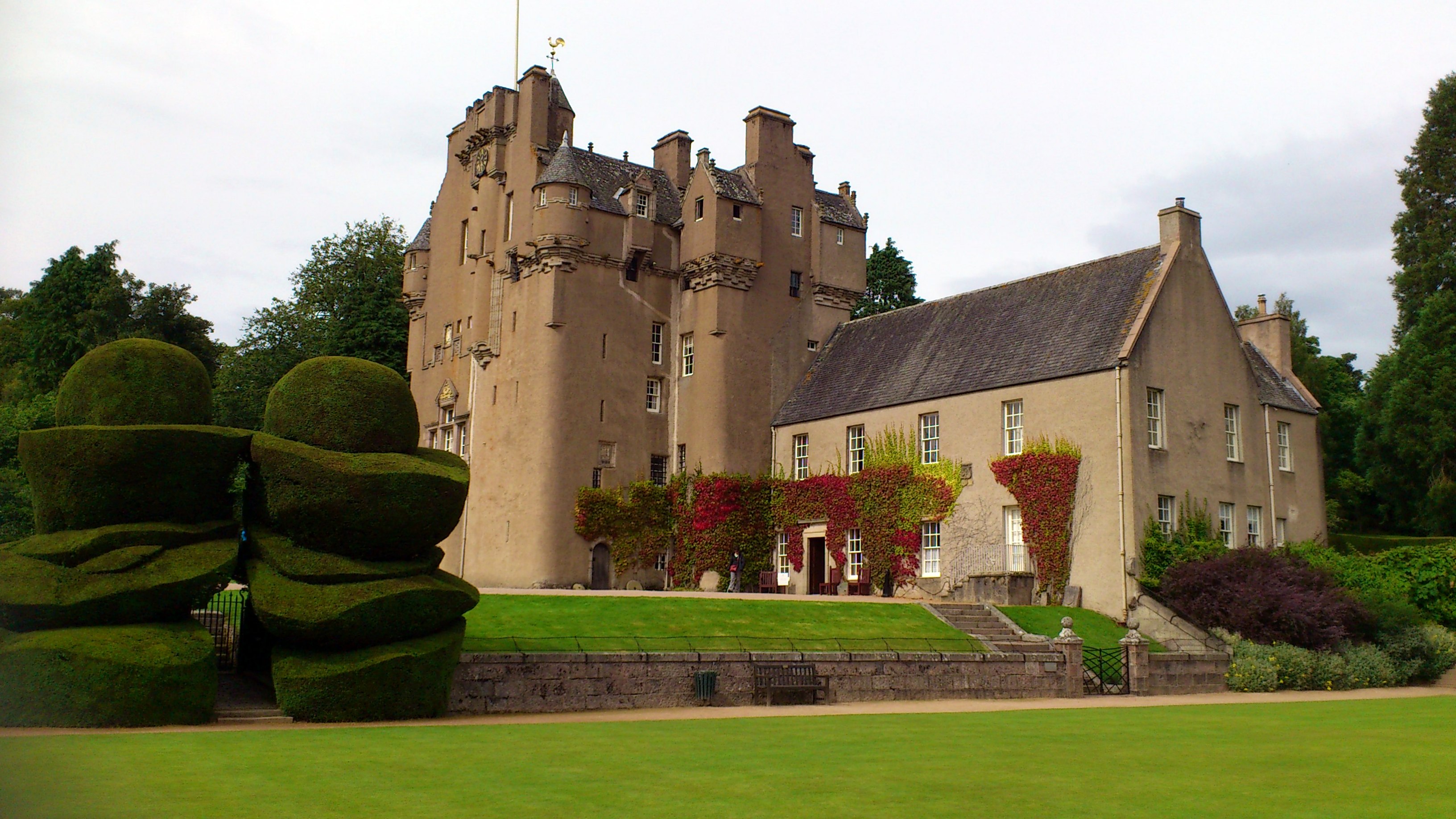
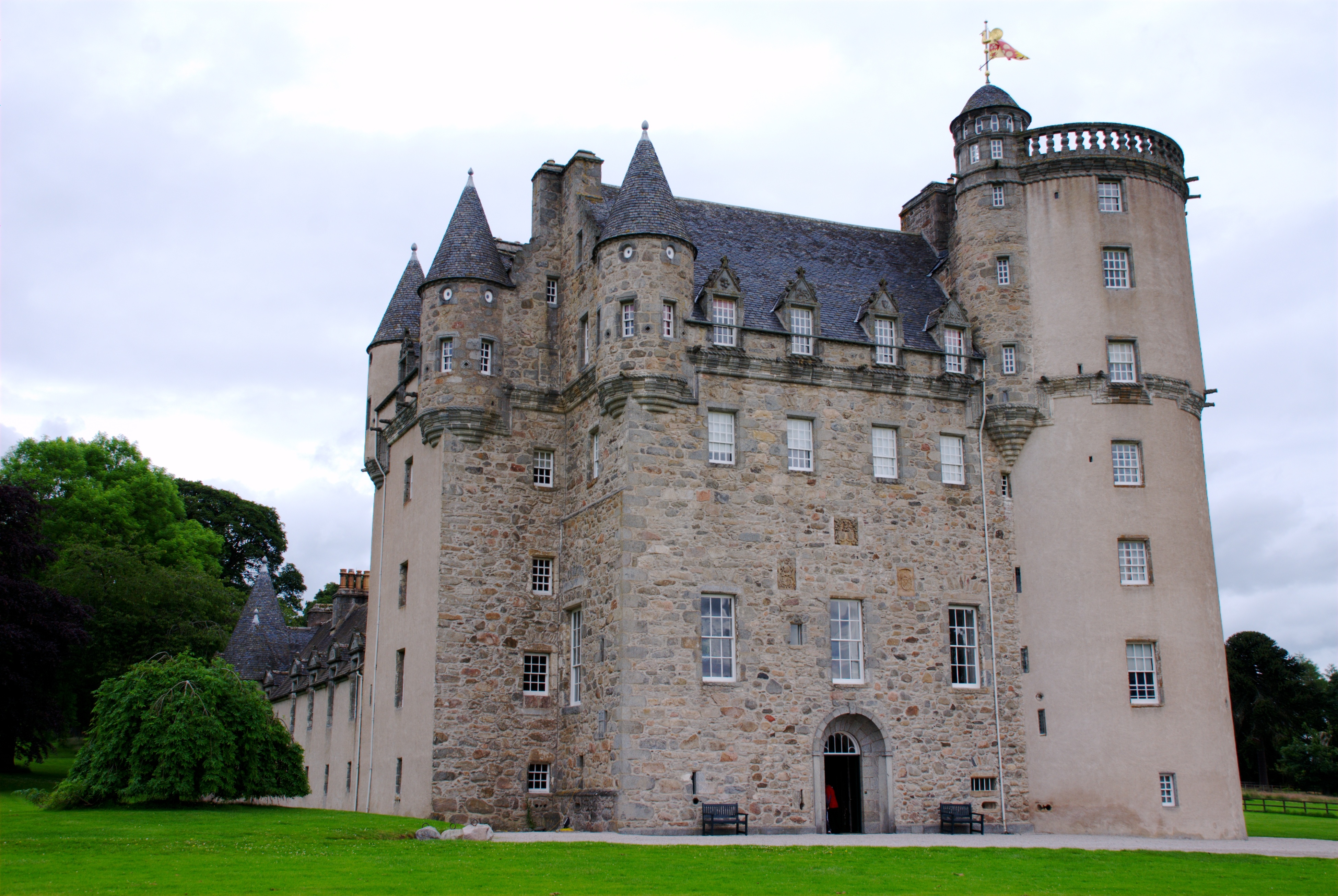
An older tower became the centre of a much grander residence. Michael Fraser began major alterations in the later sixteenth century; his son Andrew continued them. One added tower is round, the other square, giving the building its characteristic Z-shaped plan. Master mason John Bell helped create the elaborate upper work in the early seventeenth century.
Later owners reshaped both rooms and landscape. During the twentieth century, the Pearson and Smiley families restored the castle, before its gift to the National Trust for Scotland in 1976. What survives brings together several periods of ambition, changing taste and conservation.
Sources for this section · 1
02 / Reading the building
Rooms with ears
The Great Hall belongs to the castle’s older core. Look for the Laird’s Lug, its celebrated listening place: the name means the laird’s ear. Hidden routes and opportunities to overhear visitors add another dimension to a room designed for company. There is plenty to discover about how people watched and listened here.
The visitor route moves through very different tastes, from the hall to a Georgian-style dining room, a library and Victorian bedrooms. Family portraits give faces to the names. For those able to climb it, the round tower opens the view towards Bennachie and across the estate. The change from enclosed rooms to open country is part of the castle’s appeal.
Sources for this section · 1
03 / The haunting tradition
The stain that would not wash away
Castle Fraser’s best-known legend begins in the Green Room. A young woman, often called a princess, is murdered there. Her body is dragged down the round tower’s stone stair, leaving blood that cannot be removed. In the story, wooden covering conceals the stains, but the woman’s presence remains.
The Trust preserves the young-woman version; Richard Jones’s retelling, reproduced by Great Castles, calls her a princess and explicitly identifies the account as folklore. Martin Coventry’s Castles of Scotland notes that its supposed date shifts between the nineteenth century and a much earlier past. The uncertainty belongs in the telling: neither her identity nor a contemporary record of the alleged murder is established by these accounts.
A 1994 Washington Post feature records caretaker Eric Wilkinson telling the princess story.
The staircase gives the tale a physical focus. Its covering does not, by itself, establish why it was fitted. The story’s lasting power lies in the idea that a concealed act of violence leaves something behind that a household cannot erase.
04 / A person behind a tradition
Lady Blanche and the curtained portrait
The woman in a long black gown is usually identified as Lady Blanche Drummond, who died in 1874. She should not simply be merged with the unnamed victim of the Green Room story.
NTS staff member Kirstin Ingram’s collection-based account supplies a more intimate introduction. Blanche married Frederick Mackenzie Fraser in 1871. Her sewing things, jewellery, photographs and painted likenesses survive at the castle. These objects bring a young woman’s interests and appearance into view before the haunting tradition takes over.
Her portrait has curtains. Ingram explains their possible association with mourning, while carefully presenting the alternative story — that Frederick’s second wife, Theodora, disliked seeing her predecessor — as an anecdote. The castle also preserves Blanche’s hair as a keepsake.
In the haunting tradition, Blanche walks through the castle and grounds dressed in black. The published account offers no dated witness statement that identifies the apparition. Her belongings and portraits, however, are tangible reminders of a short life and the place she held in the household’s memory.
05 / Reports and household history
Music after the players have gone
The Trust records traditions of whispers, laughter and music in the Great Hall. Our earlier Castle Fraser article also repeats claims of piano music, voices and rearranged furniture. These are published reports without named witnesses or incident dates in that article; they remain leads for enquiry.
Music certainly mattered to the family. Dr Roger B. Williams’s study of the castle’s collection traces scores, signatures, correspondence and accounts. Blanche’s name appears in music volumes, including Beethoven sonatas presented in 1873. The surviving Erard grand dates from 1858, although Williams treats the identities of its likely players as an inference. A remembered household sound can be historically appropriate without that establishing the cause of a later report.
Today, The Sounds of Fraser adds researched background audio to the visitor experience. If you hear something unexpected, establish what was playing nearby before drawing conclusions. This present-day feature is a condition to record, not an explanation that can automatically be applied to older accounts.
Sources for this section · 4
- National Trust for Scotland — Castle Fraser’s haunting traditions (opens in a new tab)
- Scottish Paranormal — Original Castle Fraser article (6 September 2012) (opens in a new tab)
- Dr Roger B. Williams — Music at Castle Fraser (revised April 2020) (opens in a new tab)
- National Trust for Scotland — Castle Fraser and The Sounds of Fraser (opens in a new tab)
06 / Beyond the walls
Follow Miss Bristow into the woods
Elyza Fraser inherited in 1792 and set about changing her surroundings. Her companion Mary Bristow shared years of travel and an interest in gardens; Mary’s gardening books remain in the collection. NTS researcher Wendy Turner describes how Mary planned and planted a wooded walk between 1797 and 1800.
Miss Bristow’s Trail keeps her name in the landscape. After the enclosed stairs and stories of troubled rooms, make time for this part of the estate. Gardens and woodland offer another way to meet the people of Castle Fraser, through the places they chose to create and enjoy.
Sources for this section · 1
07 / Plan a visit
Check the castle and the estate separately
Castle Fraser is near Kemnay, north of Dunecht, with postcode AB51 7LD. The Trust advises following the brown Castle Fraser signs for the final two miles because navigation systems can misdirect drivers away from the visitor car park.
At this guide’s review on 15 September 2026, the castle, tearoom, shop and courtyard toilets were temporarily closed for maintenance until 18 September. The garden and wider estate remained open, with toilets at the walled garden. Check the official page for current opening, admission and notices before travelling.
Gravel limits wheelchair access in the courtyard. The Trust can arrange ground-floor castle and tearoom access through the front door; contact 01330 833463. A reception screen shows the upper rooms, and the scented walled garden is wheelchair accessible. Read the detailed access guide to plan a visit that suits you.
Sources for this section · 1
Prepared for Scottish Paranormal / Haunted Scotland.
Sources and visitor information reviewed 15 September 2026.