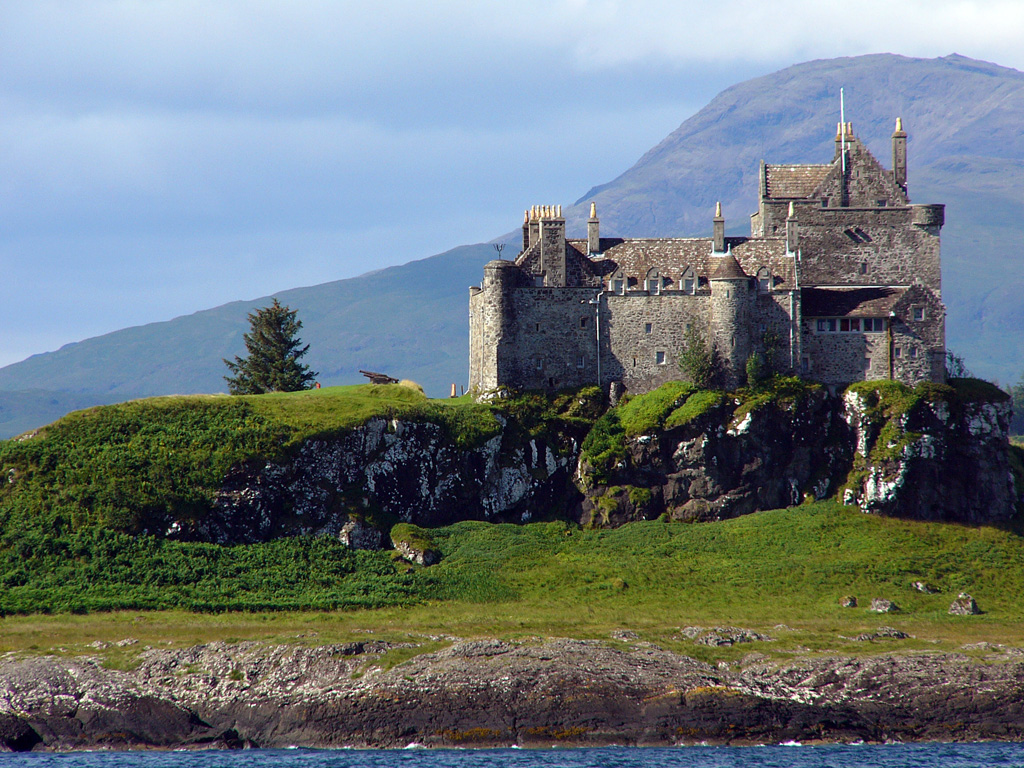
01 / The documented castle
Medieval roots and a twentieth-century rebirth
The castle’s own timeline places its beginnings in the twelfth or thirteenth century and lists several possible founders, including Alexander II, Alexander III and an Earl of Ross. A precise foundation in 1220 should therefore be treated cautiously. Later entries trace its association with the MacKenzies and the MacRaes who served as its keepers.
The present skyline owes much to Lieutenant-Colonel John MacRae-Gilstrap and the reconstruction begun in 1912. Architect George Mackie Watson and local clerk of works Farquhar MacRae helped bring the project to completion. The formal opening took place on 22 July 1932, with the arched bridge also finished. Public admission followed in 1955.
Historic Environment Scotland describes a creative interpretation of the earlier castle, incorporating remains of its keep and enclosing walls. The gatehouse, turrets and courtyard composition belong to that twentieth-century project. Medieval fabric survives within a later vision of a Highland stronghold.
That distinction enriches a visit. You are looking at a place repeatedly reshaped by its occupants, with the bridge and familiar silhouette marking one especially ambitious chapter. The age of the site and the age of every wall are different questions.
02 / The Jacobite rising
Why Spanish soldiers came to the island
In 1719 Spain supported a Jacobite attempt to restore the exiled Stuarts. Historic Environment Scotland records a small expedition of roughly 240–300 Spanish troops reaching Loch Alsh in April and establishing headquarters at Eilean Donan. A larger invasion fleet intended for England had been wrecked in a storm, leaving the northern venture isolated.
The castle became a store for provisions and ammunition. In May, Royal Navy warships bombarded it, and an assault from the ships forced the defenders to surrender. The captured gunpowder was then used to destroy the stronghold. The military history gives the Spanish connection a substantial foundation without identifying any individual later associated with a ghost story.
The campaign continued inland. On 10 June, government troops defeated the Jacobite force at Glen Shiel. These were separate engagements in the same rising: the attack on the island castle and the subsequent battle in the glen. Keeping them distinct matters when considering traditions about where a Spanish soldier might have died.
Sources for this section · 1
03 / Life behind the defences
Small objects bring the household into focus
National Museums Scotland’s account of the excavations, written by curator Dr Alice Blackwell, opens a more intimate window onto medieval Eilean Donan. The finds reflect skilled work and ordinary recreation, alongside defence and lordship. They make it easier to picture the island as a place where people lived throughout the year.
Fragments of crucibles, the vessels used to melt metal, retained traces showing that fourteenth-century craftspeople worked copper, silver and gold. Later ironworking produced practical objects such as nails, keys and knives. These remains connect the castle to the hands that maintained its buildings and equipped its household.
Other finds suggest moments of leisure. Playing pieces were made from decorated bone or reused pottery. Small pierced pig bones are interpreted as possible buzzing toys, made by winding and releasing a cord. Their purpose remains an archaeological interpretation, but it is a vivid one: even within a powerful stronghold, children may have found amusement in material left over from the kitchen.
Sources for this section · 1
04 / The reported haunting
Carlos and the footsteps after closing
The castle’s own website gives the Spanish-soldier tradition a specific modern setting. In a post dated 25 July 2022, it calls the figure Carlos, associates him with the exhibition area and reports that staff regularly hear footsteps there after visitors have left. This is an operator-published report; the individual listeners are not named.
The same short account suggests that he might have been a victim of the 1719 rising. It does not establish a historical identity or describe the circumstances of a death. Nor does it give encounter dates, recordings or details of checks made when the sounds were heard. The reported footsteps and the proposed explanation therefore remain distinct.
Scottish Paranormal’s 2012 article preserves a bedroom tradition involving Lady Mary. Its later public article, published in December 2024, uses the name Isabella for a figure associated with bedrooms and grand halls. Neither summary establishes that these names describe the same person. Keep them as separate attributed traditions unless further source material connects them.
05 / From the Scottish Paranormal archive
The team’s published account
Scottish Paranormal’s December 2024 article states that its investigators and Premium Club members captured audio anomalies, unseen movements and temperature fluctuations at Eilean Donan. It also summarises accounts attributed to staff and visitors, including voices, fleeting shadows and perfume in empty rooms. These are claims made in the public article.
The summary points to extensive case material and witness testimony, but it does not set out the complete recordings, dated logs or full statements. For any particular incident, its conditions, sequence and checks matter. A brief public description cannot convey everything recorded at the time or establish the cause of an anomaly.
Readers can follow the public overview below or continue to Scottish Paranormal’s existing Premium case through the appropriate membership. The distinction matters: the overview introduces the team’s reported findings, while a close assessment requires the individual records and their context.
Sources for this section · 1
06 / Planning a visit
Buy your ticket when you arrive
Checked on 15 September 2026, the castle sells admission tickets on site on the day of the visit; its website says it does not offer advance online ticketing. The published September timetable is 9.30am–6pm, with last admission at 5pm. Allow enough time to enjoy the rooms as well as the exterior.
For 1–24 October, the advertised opening is 10am–6pm, with last admission at 5pm. From 25 October to 22 December it becomes 10am–4pm, with last admission at 3pm. Recheck the official page before travelling, particularly around seasonal changes. The visitor centre and individual food or retail outlets have their own hours.
Rucksacks and large bags are not permitted inside the castle. Free security lockers are available beside the main visitor centre. For practical enquiries, contact 01599 555202 or info@eileandonancastle.com. The postal address is Eilean Donan Castle, Dornie, by Kyle of Lochalsh, IV40 8DX; use the operator’s directions to plan your arrival.
Sources for this section · 1
07 / Choose the visit that suits you
The island and interiors offer different experiences
The operator’s access statement describes uneven steps, narrow stairs and corridors, and changes of floor level inside the castle. These present substantial barriers for people with limited mobility, and the interior is generally unsuitable for wheelchair access. Discuss your particular needs with staff before buying admission.
Exterior access is a separate possibility. The castle advertises free island access for visitors meeting its stated registered-disabled eligibility, allowing them to cross the bridge and explore outside. Some surfaces are gravel, which may be difficult for wheelchairs. A free touchscreen virtual tour is available on request in the visitor centre, including views of rooms normally outside the public route.
The visitor centre has a level approach from designated parking approximately twenty metres away, wide doors and two accessible toilets. Dogs are permitted on the island but excluded from the castle interiors under the published policy. Confirm any assistance-dog arrangements directly. A visit can still centre on the water, bridge and exterior when the stairs are unsuitable.
Sources for this section · 1
READ / SCOTTISH PARANORMAL
Explore the archive
- PUBLIC ARTICLE · Eilean Donan Castle: Scotland’s Timeless Mystery (opens in a new tab)
Read Scottish Paranormal’s published overview of the castle and the team’s reported findings. - PREMIUM · Eilean Donan Castle — Premium case (opens in a new tab)
Continue into the existing case material through your appropriate Premium membership.
Prepared for Scottish Paranormal / Haunted Scotland.
Sources and visitor information reviewed 15 September 2026.