01 / The documented castle
A duke’s power written in stone
Robert Stewart, the 1st Duke of Albany, acquired Doune in 1361 through his marriage to Margaret Graham, Countess of Menteith. The younger brother of Robert III, he exercised much of Scotland’s royal authority.
When the future James I was captured in England in 1406, Albany remained Scotland’s Governor and Guardian. His wealth supported a castle intended to impress visiting nobles and provide secure accommodation. The present building largely reflects that late medieval ambition, although evidence points to an earlier stronghold here.
Doune subsequently became a royal residence. Its role as a retreat for monarchs diminished after James VI departed for London in 1603. The halls still suggest the scale of its earlier hospitality.
Sources for this section · 1
02 / Reading the building
The castle that leaves a question open
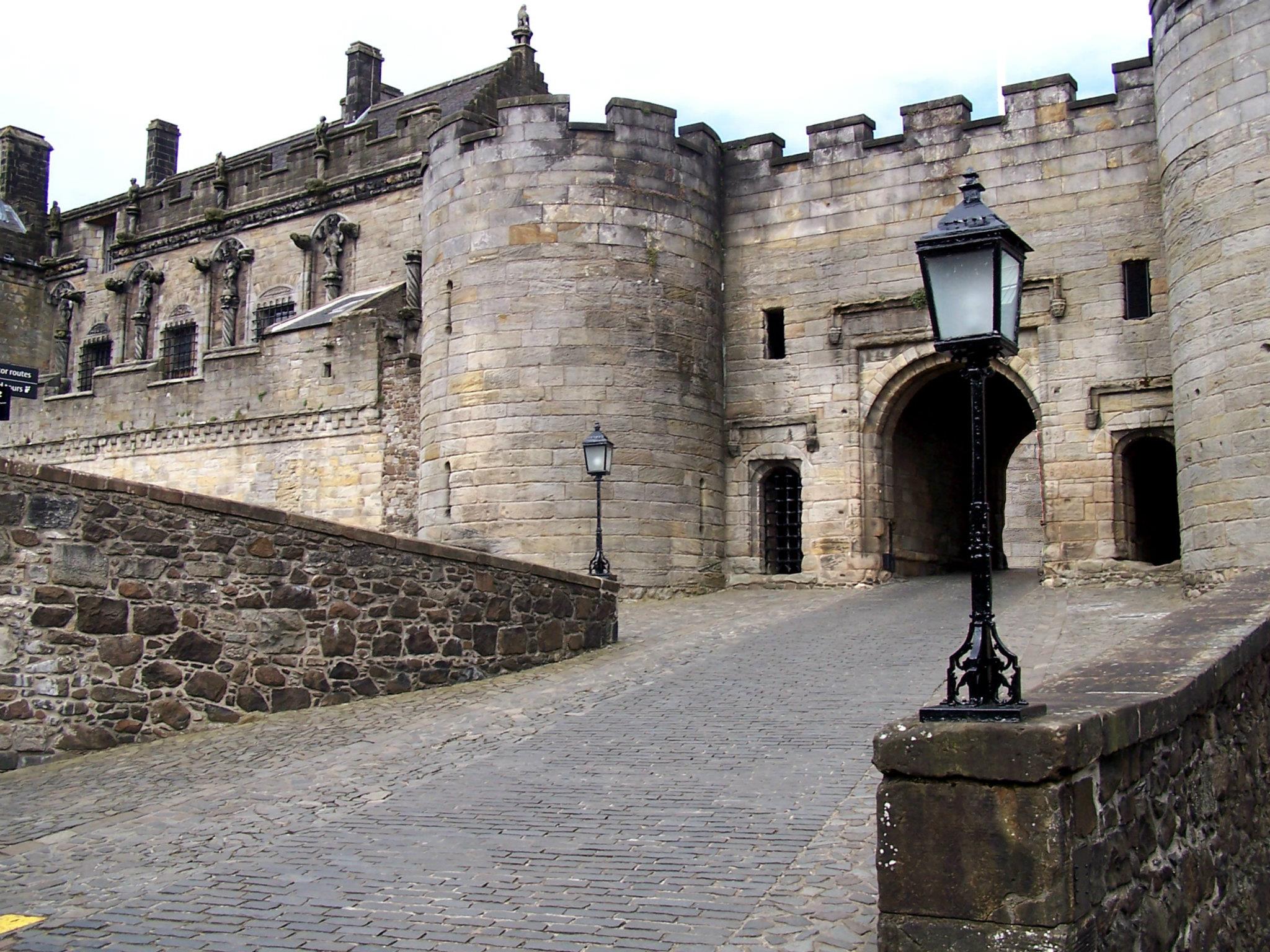
Doune occupies raised ground between the River Teith and the Ardoch Burn. Its five-storey gatehouse protected the entrance while containing the principal rooms of the duke and duchess. The great hall joined this private accommodation to the working end of the castle, where the kitchen tower stood beyond the line of the courtyard wall.
That arrangement connected defence, ceremony and domestic life. Historic Environment Scotland regards Doune as an unusually early example of planned royal lodgings, anticipating the courtyard palaces that followed. A small private chapel was another sign that comfort and status mattered alongside protection.
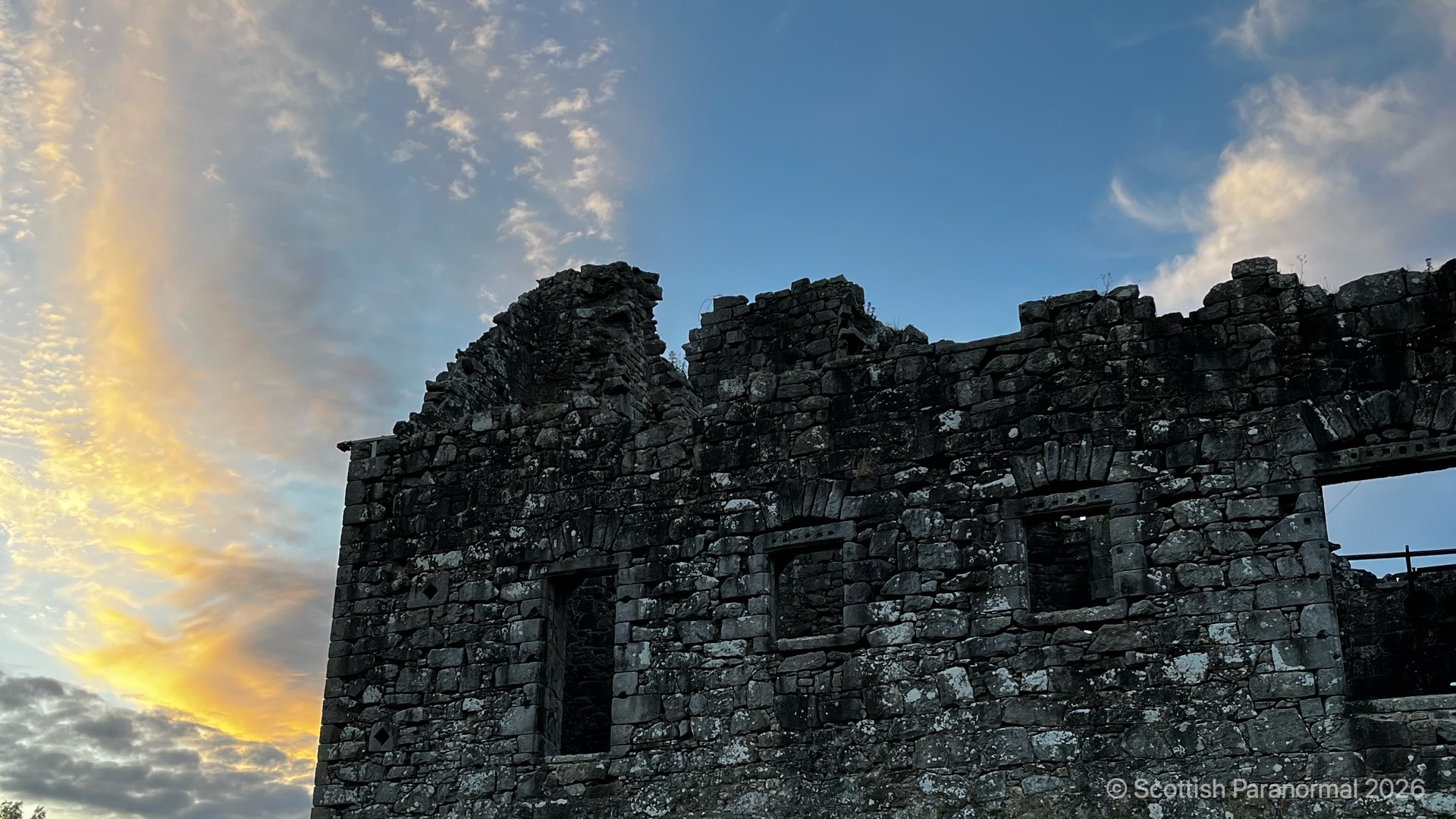
Look for the projecting stones on the kitchen tower and the fine windows in the southern curtain wall. They suggest further ranges of rooms were intended. How much was actually built remains a question: HES’s interpretation allows for an unfinished scheme or buildings subsequently removed. The gaps invite a closer look at how Doune changed.
03 / Mary Queen of Scots
A royal visitor, with a story to untangle
The older Scottish Paranormal article says Mary Queen of Scots was exiled at Doune and names her as one of its supposed ghosts. The historical connection deserves a more precise telling. Historic Scotland’s Spring 2026 magazine records her visit on 13 September 1563; it says the chamber bearing her name may have been used by her.
That careful wording matters. A room’s traditional name can preserve a royal association without proving exactly where its visitor slept. The same magazine describes the courtyard’s animal-shaped gargoyles as nineteenth-century replacements for earlier waterspouts: even a convincing medieval setting contains later layers.
Mary’s imprisonment before her abdication was at Lochleven, from which she escaped on 2 May 1568. Describing her Doune visit as exile confuses that history. Her connection with this castle can stand on its own, without turning an uncertain ghost attribution into a documented event.
Sources for this section · 3
04 / The Jacobite years
A window, knotted sheets and the ground below
The rooms above the kitchen acquired a very different purpose during the Jacobite rising. After the government army’s defeat at Falkirk in 1746, prisoners were taken to Doune. HES’s audio-guide transcript describes 150 men being held here, including a volunteer soldier named John Home.
Its account follows a small group who barricaded their chamber and tied bedsheets together to make an escape rope. On a moonlit evening they climbed out, using the improvised line to descend the castle wall. The transcript describes the rope eventually breaking as another man reached the bottom.
The story gives the height of the kitchen tower a human scale. From below, consider the distance between a chamber window and the ground, and what that descent would mean to someone trying to leave confinement. Read against the surviving building, this brief episode brings the castle’s wartime use sharply into focus.
Sources for this section · 1
05 / Reported hauntings
The woman at the window
Doune’s older Scottish Paranormal entry preserves a brief, unsettling image: a woman described as an outcast, dressed in blood-coloured velvet and looking from a window. The identification is attributed to an unnamed sensitive. The same passage mentions photographs said to show spirit balls, but does not supply the photographs or explain how they were connected with the woman.
There is no named witness, date, room or sequence of observations in that account. Mary’s supposed haunting is also stated without an accompanying encounter. This guide retains the reports as a single inherited account, with the limits of the original record left visible.
The window image has an atmosphere of its own, but it cannot yet be attached to a known person or event. Original photographs, their circumstances and a first-person description would let the story be examined more closely. For now, the woman and the photographic claim remain separate unresolved elements, rather than a demonstrated connection.
Sources for this section · 1
06 / A familiar face on screen
Come for the film, stay for the castle
For many visitors, recognition arrives before the history does. Doune supplied memorable settings for Monty Python and the Holy Grail and later appeared in the first season of Outlander. HES’s 2023 feature on the castle describes an audio guide narrated by Terry Jones, with additional contributions from Sam Heughan.
Those associations offer an enjoyable way into the site: a remembered scene gives you a reason to stop and study an archway or a stretch of wall. Then let your attention move beyond the camera’s frame. The grand hall, service rooms and courtyard belong to a building designed for a much earlier audience.
Make space for the setting too. HES highlights the views over the Teith Valley and the riverside walk behind the castle. An exterior circuit can bring the towers into a different relationship with the landscape, after the close quarters of the interior.
07 / Planning a visit
Allow for the approach as well as the rooms
Doune Castle is at Castle Hill, FK16 6EA. Checked on 15 September 2026, official opening is daily 9.30am–5.30pm from April to September and 10am–4pm from October to March. Last entry is 45 minutes before closing; annual closures are 25–26 December and 1–2 January. Online advance tickets offer the best price.
Parking at the castle is very limited. HES recommends public transport or village parking, including Draggie Burn Park & Stride, about a twenty-minute walk away. Two accessible spaces are available at the castle on a first-come basis. Check the official directions before setting out, especially if walking distance affects your plans.
The approach ends in a steep slope with uneven cobbles, which can be slippery in wet weather. The courtyard is uneven, the principal first-floor rooms require steps, and upper chambers involve spiral stairs. Read the detailed access information for your needs. Admission includes a phone-based audio guide requiring internet access; follow the instructions supplied before arrival. Recheck opening and access notices on the official page before travelling.
Sources for this section · 1
Prepared for Scottish Paranormal / Haunted Scotland.
Sources and visitor information reviewed 15 September 2026.