01 / The documented castle
Two buildings, one long-lived home
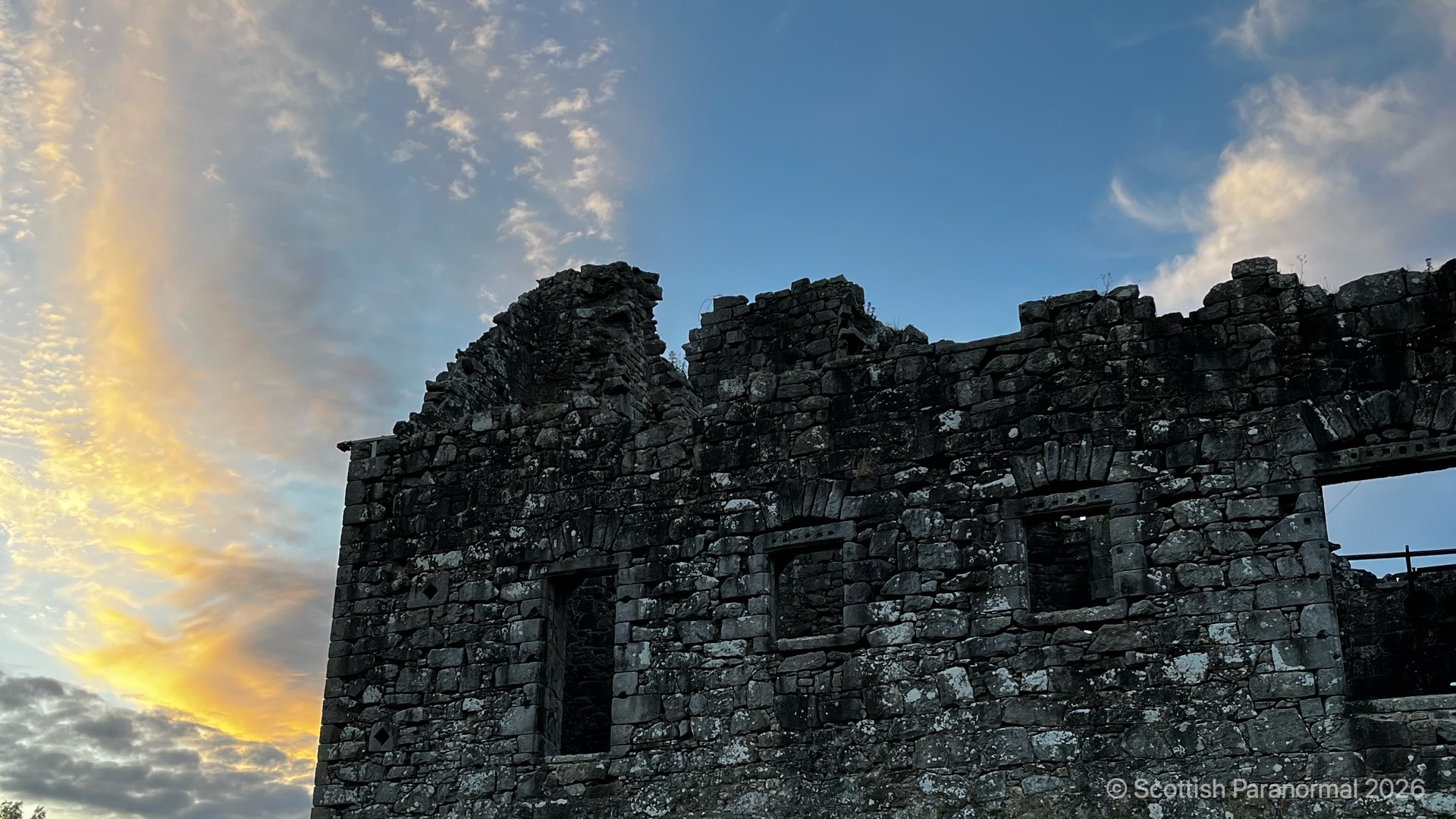
This is Castlecary Castle in the Falkirk council area, historically Stirlingshire. Historic Environment Scotland also records it as Castle Cary. The neighbouring Roman fort is a separate site, and the similarly named Somerset town belongs to a different story entirely.
The tower dates from the fifteenth century. Rather than fixing its completion to the precise 1478 given in our original entry, the surviving heritage record supports that broader date. The eastern addition carries the much firmer evidence of 1679 above its doorway. The castle has been Category A listed since October 1972.
Architects David MacGibbon and Thomas Ross described the building in their 1889 survey. They measured the old keep at about 34 feet by 23 feet, rising 42 feet to its battlements. A stair at the north-west corner connected the upper floors and attic to the roof walk. Below, a vaulted ground floor was originally lit by a narrow slit towards the courtyard.
Their account shows how the later house changed daily life. The eastern wing supplied a kitchen and additional rooms, while a new entrance and stair served both parts. An iron yett, a latticework gate, survived inside; the architects thought it might have belonged to the earlier keep.
Sources for this section · 3
- Historic Environment Scotland — Castle Cary, LB10519 (opens in a new tab)
- Historic Environment Scotland, Trove — Castlecary Castle, record 45827 (opens in a new tab)
- MacGibbon and Ross — The Castellated and Domestic Architecture of Scotland, vol. III (1889), Castle Cary, pp. 439–441 (opens in a new tab)
02 / Evidence beneath the house
The ditch under the kitchen wing
The castle’s defences extend below the standing walls. In 1996, work by Falkirk Museum before a new sewage installation uncovered a ditch 7.5 metres wide beneath the seventeenth-century extension. It had been deliberately filled before the wing was built. Archaeologist G. B. Bailey suggested that it might belong to the original tower’s period.
That discovery offers a physical glimpse of an earlier setting, before the building took on its present domestic outline. Older Ordnance Survey visits also recorded the restored tower and eastern range in use as a house, with only the lower part of the western courtyard wall apparently original.
Roman masonry was reused in the castle, as the local history society’s study explains. The stones are older than the tower. At the separate Roman fort, Historic Environment Scotland records the removal of building material from at least the fifteenth century. Ancient stone in a later wall should not turn the medieval house into a Roman castle.
Sources for this section · 3
- Historic Environment Scotland, Trove — OS observations and G. B. Bailey’s 1996 excavation note (opens in a new tab)
- G. B. Bailey, Falkirk Local History Society — Castlecary Castle (2020) (opens in a new tab)
- Historic Environment Scotland — Castlecary Roman fort: history and stories (opens in a new tab)
03 / History and a disputed refuge
General Baillie’s flight from Kilsyth
William Baillie was a real Covenanter commander. On 15 August 1645, his army suffered a crushing defeat at Kilsyth against the Royalists led by Montrose. Historic Environment Scotland’s battlefield account describes his escape after becoming trapped in Dullatur Bog, eventually reaching Stirling Castle.
Local tradition inserts Castlecary into that flight: Baillie supposedly sheltered here overnight, left before his pursuers arrived and escaped while the castle was burned in reprisal. G. B. Bailey’s local history study questions the account, including its claim that a Baillie relative already owned the property; the study dates that family’s acquisition to 1685.
The battle belongs securely to 1645, although both the local study and our 2024 article print 1646 in this passage. The overnight refuge remains a disputed tradition. Neither the battle itself nor the shared surname establishes why a later apparition should be identified as the general.
Sources for this section · 3
04 / The local love story
A plaid beneath the window
Lizzie Baillie’s story begins with a choice her family refuses to accept. In the version retold by Greg Stewart for Scottish Paranormal, she loves Donald Graham, a man without the position her father expects of a future son-in-law. Ordered to abandon him, she continues seeing him in secret.
Discovery brings confinement in an upper room of the tower. Sympathetic servants carry word to Donald, who arrives with three companions. Each takes a corner of his plaid and holds it beneath the window. Lizzie jumps, lands safely and escapes with them into the night.
The later ending darkens the romance. Her father is said to die heartbroken, and Lizzie, overcome by remorse, follows him to an early grave. These deaths form part of the telling, rather than a sequence established here through contemporary records. Crucially, she survives the leap: the castle legend should not be rewritten as a fatal fall.
Sources for this section · 1
05 / Following the story into song
Donald in the legend, Duncan in the ballad
An older strand survives in Bonny Lizie Baillie, number 227 in Francis James Child’s collection of English and Scottish popular ballads. In its A text, Lizie meets Duncan Grahame while visiting her sister. His Highland life attracts her, though she worries that she cannot milk cattle or speak Gaelic.
The song names Castle Carry, follows her rejection of other suitors and has her exchange Lowland finery for tartan and practical shoes. She tells her father that a minister has married them. Its closing scene is a farewell to her family.
This version contains neither a leap from a tower nor the return of a ghost. Those differences are useful: the song preserves a romance with its own shape, while the castle tradition supplies a dramatic escape and sorrowful aftermath. The change from Duncan to Donald is another reason to keep the versions distinct. Their overlap records a lasting story, without proving every episode happened as described.
Sources for this section · 1
06 / The reported apparitions
A figure at the window, a lady on the stair
Our September 2012 entry describes unexplained noises attributed to General Baillie and a figure reportedly seen at an upper window by people looking from the garden. It also identifies a White Lady with Lizzie, placing most sightings on the principal stairway.
Greg Stewart’s 2024 account adds the tradition that Lizzie appears at the castle and at her father’s grave. It does not identify that burial place. These are published retellings: the reviewed articles supply no named witness, dated encounter or original recording for either apparition.
That leaves two distinct questions for future research: what people experienced, and how those experiences became attached to Lizzie or the general. A family story can suggest an identity without establishing it. No personal HSI visit or investigation result is claimed here; first-person testimony, if later supplied, can be considered on its own detail and circumstances.
07 / The castle today
A private home and a separate public site
Castlecary survived serious twentieth-century deterioration through successive restoration work. The local history society credits Hugo Millar and those who helped him, Doreen Hunter’s support and later repairs supervised by conservation architects. Its continued use as a home is part of that survival story.
The castle is described as a private residence with no public access. No visitor-opening arrangement was verified for this guide. Respect the house and gardens, and do not use accounts of past visitors or photographs as permission to approach the windows or enter the grounds.
For a public heritage visit nearby, the separate Castlecary Roman fort is free and open year-round according to Historic Environment Scotland. Follow its own directions from the B816 via the road marked Walton, and wear strong footwear. Those arrangements apply to the fort alone. Access information was checked on 15 September 2026; our castle photograph dates from November 2011.
Prepared for Scottish Paranormal / Haunted Scotland.
Sources and visitor information reviewed 15 September 2026.