01 / The documented castle
A family home behind a grand façade
The present building grew through centuries of alteration. Falkirk Local History Society identifies the southwest tower as its oldest surviving part, dating to the late fifteenth century. The Bruce family developed the property, with an eastward extension in the sixteenth century and another wing in 1581 creating an L-shaped residence.
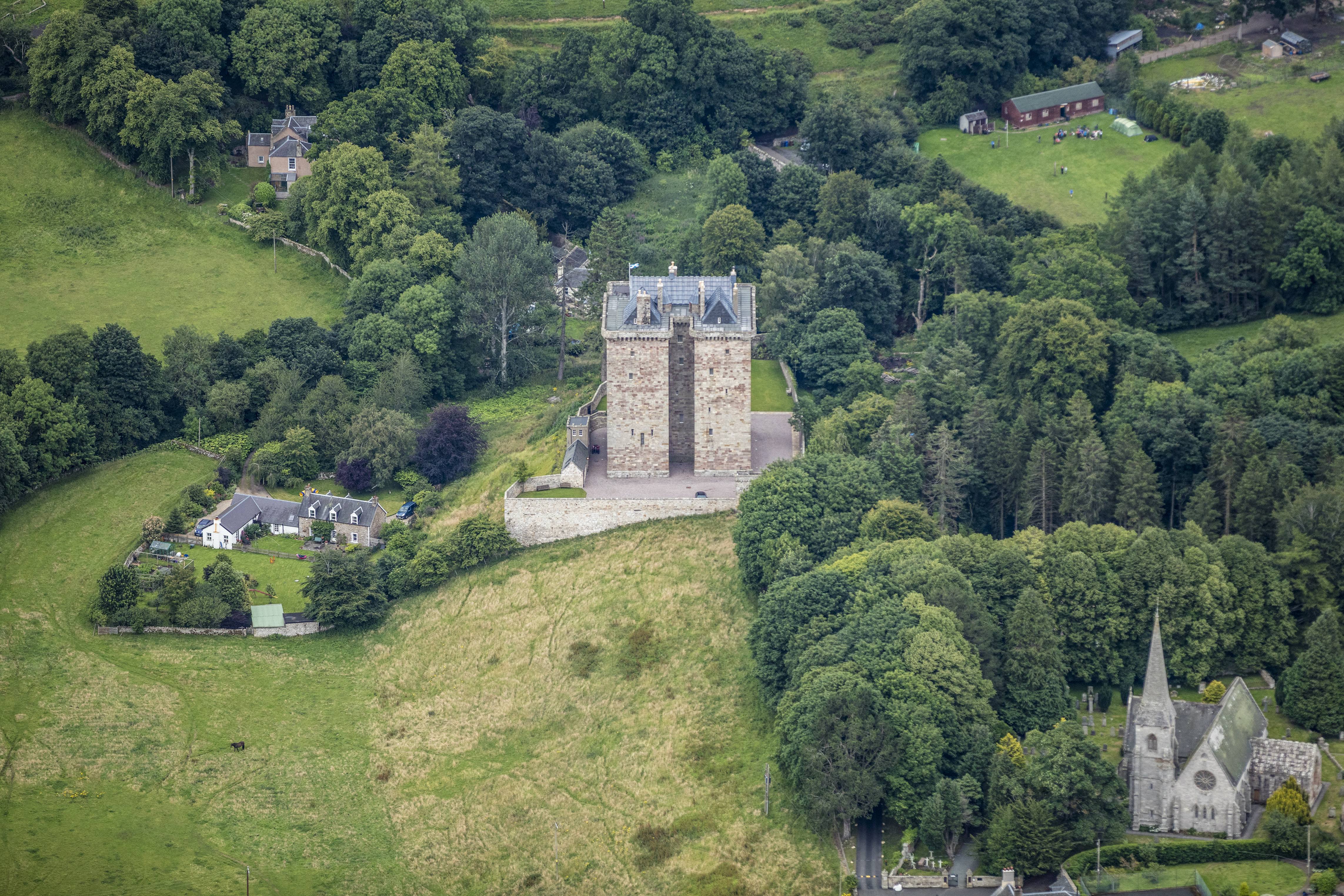
The familiar frontage arrived much later. Historic Environment Scotland credits David Hamilton with the early nineteenth-century design. Its paired round towers, central battlemented feature and Gothic entrance give the building a theatrical dignity. In older photographs, the regular rows of windows make it easy to imagine a substantial household spread through the rooms behind them.
Airth’s Category A listing recognises its architectural importance. Its value lies in this mixture of periods: defensive tower, enlarged family residence and ambitious country-house frontage, all held within one building.
02 / The earlier tradition
The rescue behind Wallace’s Tower
The name Wallace’s Tower reaches back beyond the surviving stonework. In Blind Harry’s account, William Wallace learns that his uncle, the priest of Dunipace, is imprisoned at Airth. A fisherman guides Wallace and his men towards the stronghold after dark. They enter while the garrison is at supper and fight their way through to free the captive.
Falkirk Local History Society reproduces the story within its detailed castle history. It is a dramatic medieval literary tradition about an earlier Airth stronghold. The tower standing today belongs to a later rebuilding, so its name should not be taken to mean that Wallace walked through the rooms now associated with him. The distinction preserves both the story and the building’s own history.
Sources for this section · 1
03 / The wider setting
The village that moved downhill
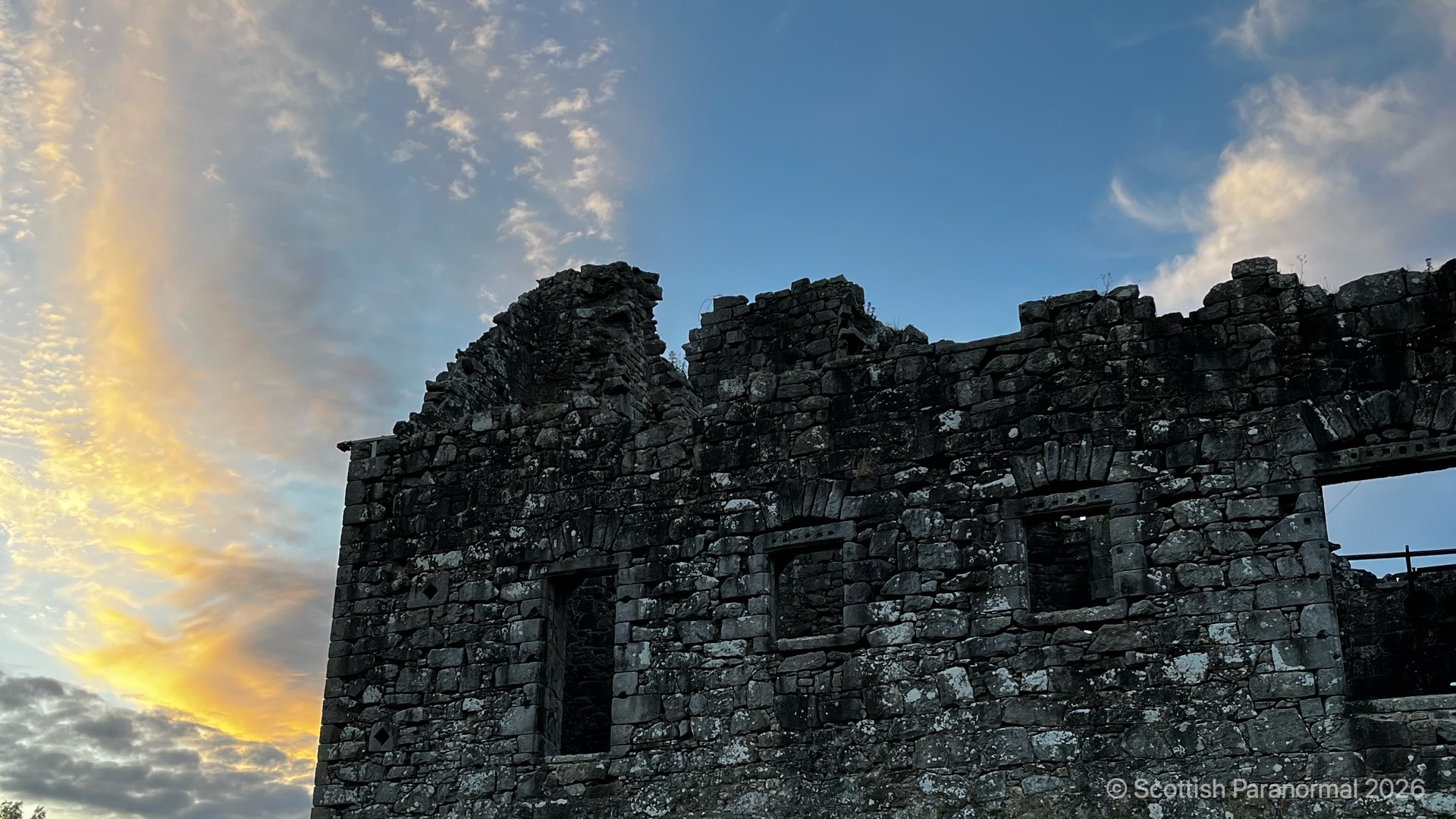
The ruined old parish church beside the castle is a reminder that this hill once held more than a great house. Falkirk Council’s conservation history places the medieval burgh in what became the castle grounds. Around the beginning of the eighteenth century, the settlement shifted downhill as Airth developed as a seaport.
The mercat cross of 1697 helps mark that changing centre of gravity. In 1820, a new church replaced the old hilltop parish church. Castle, kirkyard and village tell a connected story of worship, work and changing fortunes beside the Forth. That wider human landscape is worth keeping in view when reading tales attached to individual rooms.
Sources for this section · 1
04 / The haunting tradition
A woman still searching for two children
Airth’s most persistent haunting centres on a woman and two children. Martin Coventry records a housekeeper said to have neglected children in her care before they died in a fire. In that version, she continues searching the castle for them. Our June 2024 article tells of a nanny who also died in the blaze. The difference changes her role from a surviving, grief-stricken carer to a fellow victim.
Our earlier castle article associates the nanny with Room 9 and describes sounds of children elsewhere in the former hotel. It also attributes stories of playing children to long-serving employee Hugh Loudon. These are accounts preserved in the archive; the article does not supply his original interview or the dates of the individual incidents.
A contemporary record identifying the children, the woman and the supposed fatal fire has not been established in the sources linked here. The tradition was already circulating years before the documented fire of September 2024, which should not be used to explain its origins.
Sources for this section · 4
- Martin Coventry — The Castles of Scotland: Airth Castle (opens in a new tab)
- Scottish Paranormal — Airth Castle, 2023 archive (opens in a new tab)
- Police Scotland — Appeal and entry warning following the Airth fire, September 2024 (opens in a new tab)
- Scottish Paranormal — Echoes from the Afterlife: The Haunting of Airth Castle, 13 June 2024 (opens in a new tab)
05 / Other reported presences
The groundsman, the staircase and the dog
The earlier Scottish Paranormal entry places a groundsman’s apparition near the Bruce Suite, alongside reports of a large male figure and footprints appearing on a dusty, unused staircase. Another, darker strand describes screams associated with maids allegedly mistreated by the castle’s master. No named victim or documented assault accompanies that story in the article.
Room numbers vary between retellings, so they are best understood as details of those particular accounts. They cannot safely be combined into one definitive plan of where every experience occurred.
There is an animal presence in Airth’s folklore too. Our June 2024 article describes a phantom dog that nips at people’s ankles as it roams the hallways. Like the groundsman, it belongs to the stories gathered around the building; that account supplies no named witness or original record of an injury.
06 / A published investigation
One night at Airth, recorded in detail
Glasgow Paranormal Investigations published an account of a visit on 24 April 2009 by James Hume, Lisa Maxwell and Lorraine Anderson. In Room 9, Anderson described sensing children and a woman she interpreted as their nanny. While recording her recollections later, she associated a noise at the door handle with the boy she perceived. The report separately notes the sound on the recording.
The account includes possible voices, changing readings and equipment problems. It also preserves an unsuccessful follow-up: after a guest described an incident involving himself and a friend in the gents’ toilets, the investigators held a short vigil there and reported nothing recorded or felt.
Anderson’s impressions and the team’s interpretations are part of their testimony. The published account refers to recordings, but those original files have not been reviewed for this guide. A sound occurring during an impression does not establish its source. The named participants, date and unsuccessful vigil nevertheless make this a useful record to set beside the broader folklore.
The 2023 Scottish Paranormal article also refers to investigations by Ghostfinders Scotland. Those references should remain separate from the Glasgow Paranormal Investigations report: they name different organisations, and the earlier article does not link a dated Ghostfinders field report.
07 / Current status
Read the history; respect the closure
Airth Castle Hotel ceased trading in March 2023. The current CAMRA record still marks it closed, with its future uncertain.
Following a fire at a derelict building on the site on 23 September 2024, Police Scotland warned that the condition of the former castle and hotel made entry dangerous and said nobody should enter. Police also described fencing intended to restrict access. No verified reopening or visitor-access arrangement was found during this review.
Do not use old hotel listings, wedding pages or investigation reports as an invitation to enter. Follow barriers and current local notices. The exterior photograph shown here was taken in March 2015, before the closure and later fire; it is an archival view of the castle.
Status checked 15 September 2026.
Prepared for Scottish Paranormal / Haunted Scotland.
Sources and visitor information reviewed 15 September 2026.