01 / The documented castle
The tower within the country house
Historic Environment Scotland describes a three-storey, L-shaped tower house dated 1583. Built of irregular stone, it has an armorial panel above the entrance carrying the appeal “The Lord defend this Hous.” A small projecting turret sits above it. These details belong to the castle’s defensive identity, even as later work softened its appearance.
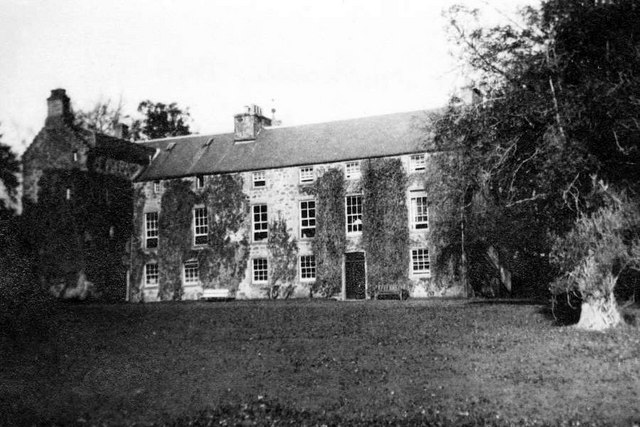
The house grew around that core. The listing records an early nineteenth-century addition incorporating older masonry, renewed crowstepped gables and a turret dated 1831. A long gallery runs along the north side beneath a ribbed plaster vault. Its generous windows speak of a household seeking light and comfort.
The names Ashintully Castle and Ashintully House describe the same evolving building. An Ordnance Survey visit in April 1968 recorded the restored castle and its 1583 doorway date. The earlier tower survives within the residence; it is not simply a vanished predecessor to the house in the photograph.
02 / A recorded confrontation
The siege behind the family stories
The Spaldings’ world could be dangerous even close to home. Robert Scott Fittis’s Book of Perthshire Memorabilia recounts an attack on Ashintully in 1597, when Andrew Spalding was taken prisoner by an armed company with whom he had a feud. Fittis traces the episode to the Books of Justiciary and names the men called before the court on 24 November 1598.
The account describes a lengthy list of local gentlemen rather than an anonymous band of raiders. That gives the confrontation a different texture: rival households, local alliances and a dispute carried from the castle into the courts. Our later haunting article places the capture in 1587. This guide follows Fittis’s dated account of the 1597 attack and the subsequent proceedings; the difference should remain visible when comparing sources.
These proceedings provide a firmer historical setting for Ashintully’s reputation. They do not establish the identities or deaths of the people in its ghost stories. A recorded siege and a tale told beside a hearth each need their own source.
03 / The haunting tradition
A green dress and a room remembered
Green Jean appears in two different ways in our archive. The older castle entry places her among the trees of the family burial ground and leaves her identity unexplained. Greg Stewart’s 2023 account tells a fuller legend: an uncle kills Jean and her maid during a quarrel connected with her decision to wear green. The maid is hidden in a fireplace; Jean receives a family burial.
A much earlier printed trace survives. Notes and Traditions Concerning the Family of Spalding, published in 1914, reproduces an undated Blairgowrie Advertiser passage mentioning “Green Jane’s Room” and its murdered, haunting namesake.
That older reference establishes that a room and a murder tradition were already associated with her. It does not supply the green-dress quarrel or identify the supposed uncle. Jean and Jane are names within the retellings, not a securely identified person with a dated death record. Keeping both versions allows the story to retain its setting without giving later detail the weight of contemporary testimony.
Sources for this section · 3
- Scottish Paranormal archive — Ashintully Castle (opens in a new tab)
- Greg Stewart — The Hauntings of Ashintully Castle, Scottish Paranormal, 5 November 2023 (opens in a new tab)
- F. J. S. and M. S. — Notes and Traditions Concerning the Family of Spalding (1914), p. 130, an undated Blairgowrie Advertiser extract (opens in a new tab)
04 / An older account of the haunting
The messenger who came back too soon
In Charles Fergusson’s account, reprinted in the 1914 Spalding volume, the messenger Crooked Davie rushes papers to Edinburgh, collects the reply and returns while his master is hunting. Exhausted, he sleeps beneath the hall table. The laird finds the papers, assumes the errand was never completed and kills him before discovering the reply.
The haunting has a striking purpose in Fergusson’s telling. He recalls older men describing a young Highlander racing along the route between Ashintully and Kirkmichael, papers in hand, before a Spalding death. Davie has become a messenger of death.
Greg Stewart’s later version places the killing after a banquet and presents Davie as a restless victim of injustice. The change is worth preserving: an ominous family messenger and a spirit seeking peace are distinct interpretations of the same remembered tragedy. Neither source gives a named, dated eyewitness sighting or the original packet of letters. The older account records a tradition passed between generations.
05 / The curse tradition
A final protest beneath the trees
The third story belongs to a travelling tradesman remembered in the archive as the tinker. Greg Stewart recounts his execution for trespassing, followed by a curse that the Spalding line at Ashintully would end. The story places his death at a tree on the drive and says his apparition continues to repeat the warning.
Our older article preserves the execution tradition but supplies no name, date or trial record. Nor do these sources establish a particular surviving tree as the place of death. There is no reason to turn an unidentified tree into a destination for visitors.
The estate did leave Spalding ownership. The 1914 family volume reproduces financial proceedings concerning the judicial sale in 1766. Those records offer a documented route through debt and sale; they do not establish a supernatural cause. The curse remains a story about an injustice remembered after the people who held power had gone.
Sources for this section · 3
- Greg Stewart — The Hauntings of Ashintully Castle, Scottish Paranormal, 5 November 2023 (opens in a new tab)
- Scottish Paranormal archive — Ashintully Castle (opens in a new tab)
- F. J. S. and M. S. — Notes and Traditions Concerning the Family of Spalding (1914), pp. 116–129, the judicial sale and financial proceedings (opens in a new tab)
06 / Present-day Ashintully
A private home in a working landscape
Ashintully remains a private residence. Simon Forder’s castle guide identifies the house as occupied and records no visitor access. The current Unique Cottages listing offers Garden Cottage in the castle grounds, reached along a private drive. A cottage booking is an arrangement for that accommodation; it should not be read as admission to the castle’s rooms.
The accommodation listing describes a working farm, guest activities and a small estate shop. It asks guests to keep dogs on leads because of livestock. Confirm arrival instructions, available activities and the routes included in your stay directly with the accommodation provider. Discuss accessibility before booking: the cottage’s listed bedrooms and bathroom are upstairs.
No regular public castle tours were verified during this review. Respect the household and follow current estate notices. The photograph heading this guide was taken by Sinclair Aytoun in 1947: an archival view of the house, rather than a promise of its appearance or access today. Information checked 15 September 2026.
Prepared for Scottish Paranormal / Haunted Scotland.
Sources and visitor information reviewed 15 September 2026.