
Thank you for joining us. This private page is where we’ll publish the audio sessions, highlight clips, and video updates as we review everything properly.
Quick facts:
Location: Balgonie Castle, Fife
Event: Public Investigation Night
Status: This page will be updated as analysis continues.
Last updated:
[29th MAY 2026 + 10:28]
Evidence Library (Raw Audio Sessions + Highlight Clips)
The DR60 EVP session files and selected clips. Highlighted clips are roughly titled or annotated where possible but open to interpretation. These captures picked up something in our environment and some we can roughly hear after processing through the software. Some things to listen for till we produce the annotated videos...
Can you hear them in the files? Please let us know if you find anything else. We’ll update you with a video if you’re struggling with the audio and need guidance on the words.
EDI+ Environmental Data


Our Dossier - Balgonie At A Glance




Submitted Content By Guests & Club - March & May 2026
Initial Feedback | MAY 25th 2026
Preliminary History & Mystery Evidence Briefing
Balgonie Castle stands above the River Leven in Fife, a place where stone, bloodline, conflict and folklore have layered themselves across centuries. The site has strong historical connections to the Sibbald, Lundie and Leslie families, with Historic Environment Scotland noting Sibbald ownership until the late 15th century, later Lundie extensions, and significant 17th-century alterations under Sir Alexander Leslie. The same listing identifies the Great Hall on the first floor, the Laird’s Hall above it, and a vaulted chapel within the castle complex.
For this return investigation, our focus was divided across three key areas of reported activity: the Laird’s Hall, the Great Hall and the Chapel. Each space produced its own pattern of phenomena, but during the first 48 hours of review, several themes began to overlap in ways that deserve closer examination.
This document is not a final conclusion. It is an early-stage evidence briefing, compiled from initial team feedback, witness accounts, equipment notes and raw environmental data. Further video, audio, EVP, ITC and participant-statement analysis is still ongoing.
Our approach remains the same as always: we present the history, the mystery, the data and the testimony side by side, allowing the audience to consider the evidence for themselves.

Historical Context: Stone, Bloodline and Unanswered Questions
Balgonie’s early history is not entirely straightforward. An archaeological report published in the Proceedings of the Society of Antiquaries of Scotland notes that early references to the castle are scarce, but records that Balgonie belonged to the Sibbald family in the late 14th century. Sir Thomas Sibbald of Balgonie is recorded as witnessing a charter in 1371, and the report attributes the main tower to the Sibbalds.
The castle later passed to the Lundie family, then to the Leslies, with Sir Alexander Leslie purchasing the estate in 1635 before becoming 1st Earl of Leven in 1641. The site was eventually sold in the 19th century and, by around 1840, had fallen into disrepair before later restoration efforts began.
This matters because several of the names and themes that surfaced during the investigation appear to touch these historical layers directly. The name Sibbald, in particular, becomes important later in this briefing.
There is also a darker strand of tradition connected with the Great Hall. The Castles of Scotland records that a skeleton was found buried beneath the floor in 1912, while also noting long-standing ghostlore attached to the site, including Green Jeanie, a 17th-century soldier, a hooded figure and other reported apparitions.
That does not prove any of the paranormal claims made during this investigation. However, it does create a historically significant line of inquiry when modern witness testimony appears to reference remains “below” the Great Hall.

The first 48 hours of review suggest that Balgonie Castle produced more than isolated impressions or single-device anomalies. The early pattern is one of overlap.
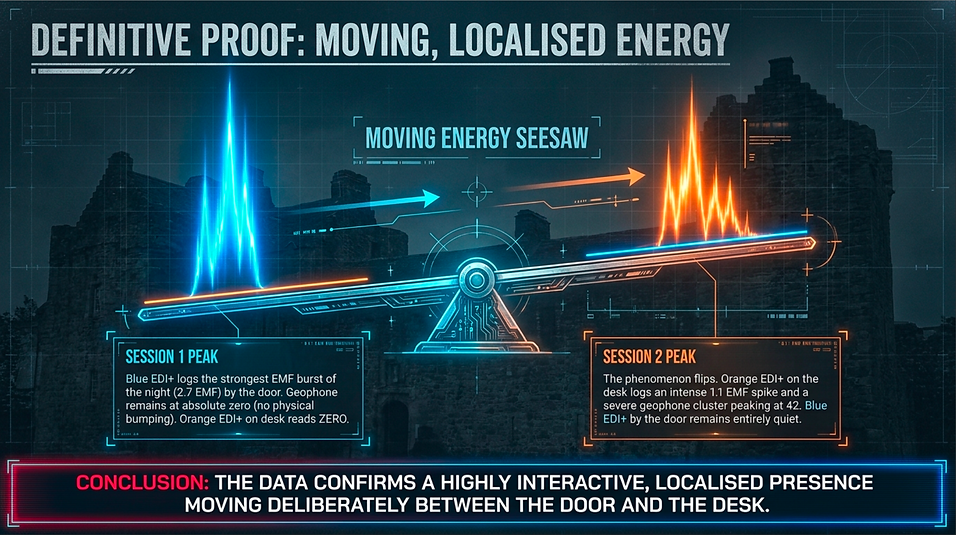
In the Laird’s Hall, equipment activity appeared localised and, at times, responsive to communication attempts. In the Great Hall, mediumship testimony introduced a darker narrative that may intersect with historical tradition surrounding remains beneath the floor. In the Chapel, the reported physical and vocal effects around Greg created one of the most intense experiential moments of the investigation.
Across all three areas, recurring names and profiles began to emerge: William, the mischievous boy; David, a disruptive or controlling presence; and Sibbald, a name deeply rooted in the castle’s early history.
None of this should be taken as final proof at this stage. But taken together, the early findings form a compelling case for deeper review.
Our strongest position is this:
Balgonie Castle has produced a series of unusual environmental readings, repeated witness experiences, historically relevant communication attempts and cross-zone identity threads that now require full evidence analysis.
The story is not finished.
The first 48 hours have given us the map.
Now we follow the trail.

Submit Your Evidence | Balgonie Castle
